Go to theallusionist.org/draculae3 to listen to this episode and get more information about the topics therein.
Check out the rest of the Draculae miniseres.
This is the Allusionist, in which I, Helen Zaltzman, try to stop language sucking the life force out of me.
This is the third episode of our Draculae miniseries; listen to episodes one and two before this one so you know what the hell is going on. There’s a summary of each of the books we’re discussing, and an explanation of why we’re talking about them. And as always, over at the show’s forever home theallusionist.org, there are links to additional information plus transcripts of the episode.
Also at theallusionist.org, there’s a playlist of relevant episodes for Pride Month, but they’re good all year round too.
On with the show.
HZ: To recap: Bram Stoker worked as a manager for the actor Henry Irving and his Lyceum Theatre in London, plus was a qualified barrister and former civil servant, wrote articles of arts criticism and stories and novels and novellas, that were not particularly successful. Until the vampire novel Dracula, which he spent at least seven years researching and writing, he published in 1897 to moderate critical acclaim and popular enough to be published in quite a lot of places around the world, and translated into several languages. It was serialised in 1899-1900 in Swedish newspapers under the title Mörkrets Makter, meaning Powers of Darkness, and it was also serialised in an Icelandic newspaper from 1900-1901 under the title Makt Myrkranna, also meaning Powers of Darkness.
It took more than 100 years for someone to point out that the Powers of Darknesses are not direct translations of Dracula, far from: they have significant differences in plot, character names, and word count. How? Why?? Who???
IRIS ICHISHITA: There's so many different ways to try and understand this text. And there are so many different pieces of evidence that point us in these different directions. Is it fan fiction? Is it pirated fiction? Is it pastiche? Is it creative licence, creative liberty? Is it an alternate version? Could it have been Bram Stoker's original version, his director's cut? What are these texts in relationship to each other?
HZ: Well, they are first cousins, I'd say?
IRIS ICHISHITA: Yeah, yeah. If not shadowy twins.
HZ: Maybe it's more like identity theft. It's so hard to say.
IRIS ICHISHITA: I'm Iris Ichishita, and I'm the producer, writer, and host of The Powers of Darkness podcast.
HZ: Iris spent five years investigating these books I've been talking about in the Draculae miniseries for her podcast series Powers of Darkness, available now in the podplaces.
IRIS ICHISHITA: There's the part of me that is the producer and the production executive and the producer for hire, who's worked many years for media companies and startups and corporations. And then there's the producer who will dive headlong into a mystery like The Powers of Darkness.
HZ: The detective, the literary detective.
IRIS ICHISHITA: Yes. The literary investigator.
HZ: Do you get a special hat?
IRIS ICHISHITA: I hope it's a deerstalker.
HZ: These texts seem to inspire just so much intrigue and devotion in people. I mean, I thought I'd made some effort by committing to reading 500,000 words of Dracula; but that's nothing compared to these people who are like, “I'm going to translate it,” or you, where you put several years into making an investigation. What was it that got its hooks into you?
IRIS ICHISHITA: Well, my work centres around subcultures that develop around mysteries, in this case a literary one. I'm also endlessly fascinated with stories where dark means light, and I'm talking about the Dracula text itself: we're talking about a very dark horror adventure that is really ultimately about that triumph of good over evil, and in some ways, if you look at it from Bram Stoker's perspective, a treatise on faith in really difficult situations. So I'm very interested in that aspect of this story specifically.
HZ: One of the mysteries that most intrigued Iris was whether the author of the Swedish Powers of Darkness was none other than... Bram Stoker himself!?!
IRIS ICHISHITA: I didn't expect to solve this mystery. I didn't expect to identify the author. But I wanted to present the best, most complete case for Bram Stoker, even though I don't necessarily believe that, it's a lot more fun to believe that Bram Stoker was involved, if not wrote the text himself.
HZ: I feel so naive for not even having thought about it as a possibility.
IRIS ICHISHITA: And so I think I wanted to present that case, because it's a lot of fun and because I think a lot of people who have been following this story have have abandoned that. It has become kind of fashionable to abandon the idea that Bram Stoker was involved in a literary sense. And I don't think that the evidence allows us to completely write him off.
HZ: Why do you think the fashion has dismissed this theory?
IRIS ICHISHITA: Because there's no hard proof; there's no direct evidence to connect Bram Stoker. And, sure, there's no evidence; but that no more proves that he did than he didn't. I guess it's just this strange kind of reversal of a lack of evidence to say that he definitively did not do it.
HZ: Would you mind explaining your case?
IRIS ICHISHITA: What set me off on a path to Bram Stoker was this whole idea of copyright, and this myth that Dracula was not properly copyrighted in the United States.
HZ: Yes, there's a remarkably sticky myth that Bram Stoker failed to complete the copyright process by filing only one copy of Dracula rather than the required two copies.
IRIS ICHISHITA: There was something very off about that, because of what we know about Bram Stoker as a barrister, as someone who was trained in the law.
HZ: Someone who can do his admin.
IRIS ICHISHITA: Yes, and who was a whiz administratively, not only for his own creative works, but for the entire creative portfolio of the Lyceum Theatre. The idea that someone of his skillset would mess up the US copyright of Dracula was just inconceivable to me.
So I really thought: what if it wasn't that he didn't properly copyright Dracula, but rather, that he purposely didn't copyright his works because he realised that a lack thereof would really help spread his story? It was this initial kind of theory that kind of set me off on: oh, is this a Bram Stoker conspiracy?
HZ: I was curious about why people would believe the copyright myth, begat because they were saying, “Well, he only filed one copy of his book, not the necessary two” – if he hadn't intended to copyright it, why would he do half the job rather than none of the job?
IRIS ICHISHITA: Yeah, good point. It could be, if you wanna go deep conspiracy theory on it, that's what he wants you to believe.
HZ: Oh, come on. Is he really playing three dimensional chess with international copyrights? Simply he's probably too busy. He's got two jobs.
IRIS ICHISHITA: Anyway, Dacre Stoker, Bram Stoker's great-grand-nephew, has disproved this copyright myth. Bram Stoker did copyright Dracula of the United States correctly. He was very careful about his rights in the US and in England and Europe.
HZ: Why do you think that that incorrect assertion has is so attractive for people? Like why do they really want that to be true?
IRIS ICHISHITA: Maybe just because of how incongruent it is with what we understand of Bram. Dacre and I have talked about this, and I don't know what it is, that there's some kind of derisive joy that comes from like, “Ah, he screwed it up! He just messed it up!” I'm not really sure why people are so ready to accept or why they want that to necessarily be the case.
HZ: It doesn’t seem that juicy. If that's what they're after, they could make up something a little more scandalous to something.
IRIS ICHISHITA: Yeah. Maybe it's also because maybe there's the contrast between how litigious Florence was and protecting Bram Stoker's copyright, whereas he wasn't; that she was protecting a legacy that he wasn't so particular about. Maybe there's something there.
HZ: Florence Balcombe Stoker, Bram Stoker's wife since 1878, became his literary executor after his death in 1912. In 1922, the German film Nosferatu appeared, based on Dracula but with some alterations to characters and story, and the English settings in the novel were relocated to Germany. The makers of the film did at points mention its source material was Dracula, but had not sought permission from the Stoker estate nor paid them for rights.
The Stoker estate was only earning measly amounts from Dracula, so Florence launched a lawsuit against Nosferatu's production company Prana Film. As these kinds of lawsuits so often do, nobody really wins. It rumbled on for three years, during which Prana Film declared bankrupcy to avoid paying out; in 1925, Florence did win the lawsuit, and the judge ordered all negatives and copies of Nosferatu be destroyed. And yet, the film managed to rise from the dead, and before the 1920s were out, Nosferatu was becoming popular in the USA.
Florence did grant rights to a theatrical adaptation, which played in England for three years; then there was a successful Broadway run in 1927, starring Bela Lugosi. Florence didn't see any money from that either – the producer died before paying the Stoker estate – but with Florence's approval, and a payment to her from Universal Studios, the play did become a film in 1931, also starring Bela Lugosi, and, oddly, it included some things that were in Nosferatu but not Dracula. Anyway it was around that time that the persistent notion began that Dracula was not in copyright in the USA.
IRIS ICHISHITA: But it really got me into the mindset that it's the kind of simplest idea that Bram Stoker wrote this, because this is his story; he did a tremendous amount of research; and he can kind of shape it however he wants, depending on his audience. And this idea that the Powers of Darkness story might actually be the story that Bram Stoker wanted to tell, but couldn't tell in England, but perhaps could tell in these Scandinavian countries, is kind of interesting. And it's not that farfetched when you consider the content.
Now, are there other authors that maybe might be more appropriate for some of the additional material that is found in Powers of Darkness? Sure. But it's not completely unreasonable to think that Bram Stoker could have been involved with that could have maybe worked with different writers and translators internationally to help his story spread across Europe, like Dracula himself wanted to do.
Was he enabling these other translations, these alternate versions that can only heighten the fear content if they're culturally more sensitive and adapted to what those culture's fears are? Could Bram Stoker have seen the benefit of that and enabled, if not orchestrated, a network of different versions across Europe?
HZ: You were talking in your show about whether he was bypassing British censorship – I just didn't know what that was like in the 1890s. What kind of situation he was contending with?
IRIS ICHISHITA: He dealt a lot with the censorship office, the Lord Chamberlain's office, which were very involved in censoring plays. But because he had a great relationship there, he was able to expedite a lot of reviews, and he was also able to maybe get some things through that other people might not have been able to get through – especially when you're talking about the might behind the Lyceum and Henry Irving, his boss, and very kind of formidable influential figures. And so he did have this relationship with Lord Chamberlain's office, but it was otherwise, from what I understand, pretty rigorous censorship, according to some pretty prudish Victorian standards.
HZ: Lots of those to choose from.
IRIS ICHISHITA: Yeah, it's kind of a wonder that Dracula was – I mean obviously we've done a lot of scholarship about Dracula now, and all of the subtext has come to the fore, but the idea that it passed through the censors even then still kind of boggles my mind.
HZ: The published version by Bram Stoker is less horny than the Swedish and Icelandic variants.
IRIS ICHISHITA: Yes, far less. Yeah. It really is. The Scandinavian versions are sexy and seductive – and really manipulative, like the Countess, for example, I mean is very manipulative, dangerous character.
HZ: The Countess is a character who appears in the Swedish Powers of Darkness to ask Dr John Seward for private treatment, in her bedroom, scantily clothed, and he is so dazzled by her beauty and maybe-supernatural seductiveness and her sucking some of his blood, that he loses first his composure, then consciousness, and, ultimately, everything.
HZ: The doctor is driven sex-mad.
IRIS ICHISHITA: Pretty much. In the blood red sex room.
HZ: Yeah. I don't even know if he enjoys himself before he's basically ended. It's rough. He has a rough time.
IRIS ICHISHITA: Yeah. Yes.
HZ: Even in the originals, I was a bit frustrated with all these men who are like, "I met Lucy yesterday and now I am in love with her forever, and I will never love anyone else." You're like, come on, guys.
IRIS ICHISHITA: Oh my goodness. So, so many of these romantic ideals and shiver chivalrous archetypes.
HZ: It’s embarrassing.
IRIS ICHISHITA: It is! And it's really weird now applying modern sensibilities to interpretations of Dracula.
WILL TRIMBLE: Although none of the relationships are consummated.
HZ: Will Trimble here, maker of one of the English translations of Mörkrets Makter, the Swedish Powers of Darkness.
WILL TRIMBLE: The prose describing the longing, the prose describing the concern about the not supernatural implications, the moral consequences of giving into temptation, is considerable. Tom Harker, who spends almost all of his narrative either dimwitted exploring the castle and finding things that are alarming, and then resisting the temptation of the sirens who are apparently calling him to his doom.
HZ: Yes, in Powers of Darkness, Harker spends much of his time in Draculitz's castle being upset by his own lust for a supernatural woman with magnificent alabaster bosom who is the Count’s late first cousin.
WILL TRIMBLE: And the fact that he succeeds in resisting that temptation seems to be rewarded with his ultimate success. I've seen it talked about as a contrast between Lucy gives into temptation and is destroyed. And Harker resists temptation and is saved as kind of like a moral motif. There is the seduction of Seward, in which the madhouse doctor is drawn into a plot. It is obscure whether he is being enchanted by magic or whether he's being surreptitiously drugged. And at the epilogue, we learned that he was a broken man. It is implied that he never speaks again. It implied that he is unable to communicate what it is that has happened to him.
HZ: Poor Dr Seward, he gets a much rougher ending in Powers of Darkness than in the original Dracula. But, at least he gets more to do in the Swedish version? Among other alterations and innovations in Mörkrets Makter.
WILL TRIMBLE: Oh, I mean, it's just wonderful. The first third of the novel is an expanded, enhanced, kind of better storytelling version of Harker’s adventure in the castle.
The last quarter of the novel, the hunt for the vampire is wrapped up in the style of Sherlock Holmes. They take most of the things that were in Dracula – we're hunting this guy, we've gotta hunt him down; we've got awareness of his magical constraints on our side –
HZ: In the original Dracula, the team goes to Romania and sits around waiting for the Count to return home along their route, whereupon they intercept him in his travel-coffin and kill him. Whereas in the Swedish Mörkrets Makter:
WILL TRIMBLE: And they chase him down through the streets of London with detectives and bicycles, and policemen dressed as labourers.
HZ: Also they chase him down to this modern, suburban house, even though Dracula has been established as a snob about new buildings, but it all just culminates in darkness lurking in the ordinary suburbs. Do you have any opinion on why this denouement, which is different to the original quite massively, like it's a different country, it's a very different scene? What are they trying to say? They kill Dracula in this freshly decorated suburban house, which is not a scene that I think most people would've anticipated.
WILL TRIMBLE: The Swedish translator got a commission to adapt Dracula for the Swedish newspaper and was not given constraints. You can do what you want with it.
HZ: Fun.
WILL TRIMBLE: So I would suspect, to the extent that the end of the novel changes away from the mystical surveillance of Dracula on the continent via hypnosis to detectives chasing down a violent criminal – I suspect it reflects the personality or the literary experience of the author.
HZ: That author being still-unknown, the text only attributed to the name A—e.
WILL TRIMBLE: Most of the newspapers had fiction in them. A couple thousand words of fiction were printed each day typically. These newspapers, because they were Swedish, often had foreign literature, published in translation, and they always used the word for 'translation'. There would be a title page and it would have the title in Swedish and it would have perhaps the title in the original language. They would say, "This is a translation from the German,” “This is a translation from the English, and here's the name of the translator." Uncommonly, the translators were anonymous. More often they just named the translator, because, why not? This was the only piece of fiction in this newspaper in this decade that used the Swedish word for 'adaptation'.
HZ: The title page says:
Mörkrets Makter
Roman ap Bram Stoker
Svense Bearbetning for Dagen ap A—e.
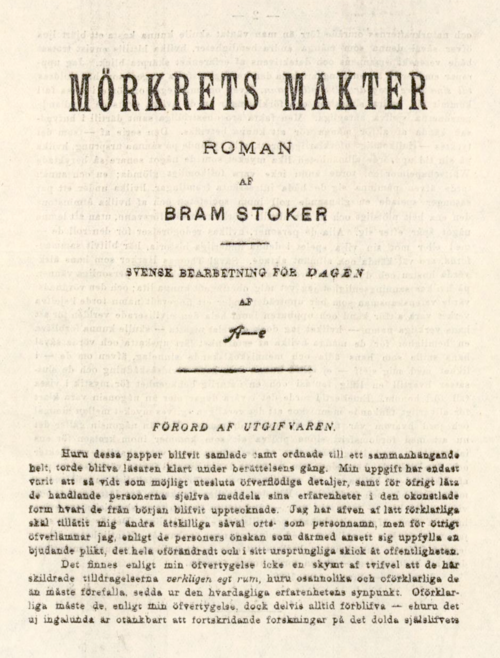
Meaning:
Powers of Darkness
Novel by Bram Stoker
Swedish adaptation for Dagen (that’s the newspaper it was published in) by A—e.
The word ‘bearbetning’ is the one that caught Will Trimble’s interest, meaning adaptation or reworking.
WILL TRIMBLE: It did not use the word whose meaning is most closely 'translation', and it seems like the puzzle over "What is this?" is most easily understood as lying in plain sight on the title page: the author took the story of Dracula, wrote with a free hand.
The author didn't recognise all of the Shakespeare quotes; most of the Shakespeare quotes don't survive the translation. I was able to spot an exceedingly large number of casual Biblical references. I presumed Swedish culture at the time was using Biblical allusions the way that Bram Stoker was using Shakespeare quotes; it was a set of commonly understood idioms to compare things to.
But the author inserted far more mentions of musical theatre and opera – likes musical theatre a very great deal. The translator was comfortable with the kind of murder mystery detective style; loves Sherlock Holmes, seems to use plot elements from some of the early Sherlock Holmes stories, the later Sherlock Holmes stories hadn't been written yet. The author likes to ramble about the boundaries of knowledge and, the boundary between the supernatural and the natural and the belief and the non-belief in the occult; loves to ramble about hypnotism, and I appreciate that in one place, in Seward's voice, the hypnotism is mentioned extremely prosaically; hypnotism is treated like the vent on a plumber's drain when he writes about it in Seward's voice. When other characters are talking about hypnotism, it carries grander consequences and moral significance. That one touch I noticed: when Seward is talking about it, it is a tool; and when other characters talk about hypnotism, it is the tip of the iceberg of the unknown. And that plays to character really well. This is our unimaginative character here.
HZ: In Dracula, there are several scenes in which Lucy Westenra’s three suitors, plus Dr Van Helsing, give her transfusions of their blood, to try to stop her wasting away from being vamped, and as an act of romantic devotion.
WILL TRIMBLE: It seems like Stoker was really, really enchanted by the transfusion, and the translator, maybe not so much.
HZ: Agree with the translator there.
WILL TRIMBLE: Our modern view of transfusion is just that this is a piece of technology.
HZ: And in the late 19th century, transfusions of human blood were still quite a novel technology, one that was not yet considered very medically legitimate thanks to the high rate of mortality - blood groups weren't figured out until 1901, after all these books were written.
WILL TRIMBLE: But they invested the blood with spiritual significance in a way that maybe didn't hold up even in 1899.
HZ: To be fair, it does seem on theme in a book about vampires for blood to be significant - although actually, in all three of these books, there isn't a whole lot of what we would expect from vampires.
IRIS ICHISHITA: Um, yeah. You're talking like fangs penetrating necks and drinking of blood and that kind of stuff. Yeah. There's almost no blood in Powers of Darkness. It's bizarre. And especially in the Icelandic translation, which is so truncated and abridged.
HZ: No time for blood.
IRIS ICHISHITA: I mean, no time for blood in a vampire novel? There's something wrong with this adaptation.
HZ: Real marketing blunder.
IRIS ICHISHITA: You're right, there really isn't a lot of that. There's a lot of these like soliloquies and pontificating and philosophies and ideals…
HZ: That Van Helsing, oof. Imagine being trapped in a lift with him.
IRIS ICHISHITA: Yes, that would feel like a long, extra, long time. Whoa.
HZ: Back to the idea that intrigued Iris so much that Bram Stoker was secretly the author of Powers of Darkness: one of the pieces of evidence that people have taken to mean that Bram Stoker did write it himself was that it included a preface, signed with the initials 'B.S.' - try not to snigger at the back, please, that's not supposed to be a hint. The preface said that Thomas Harker and Dr John Seward were his real-life friends and all the events actually happened. I don’t think this was intended to dupe people; this is not an unusual literary device, to make it sound like a novel is actually factual.
HANS CORNEEL DE ROOS: I think everyone recognises this fiction, but still it was a literary construction that worked. You know, people were kind of intrigued by it.
HZ: This is Hans Corneel de Roos, who begat the English translation of the Icelandic version of Powers of Darkness, Makt Myrkranna.
HANS CORNEEL DE ROOS: And then very interesting: where the Icelandic preface ends, the original Swedish preface continues. There were some thoughts that were plagiarised, almost copied, from the memoirs of a Swedish priest.
HZ: Hm! Strange.
HANS CORNEEL DE ROOS: Very strange.
HZ: In your opinion, did Bram Stoker have anything to do with this preface?
HANS CORNEEL DE ROOS: I think he had nothing to do with it, because he couldn't read Swedish. The Swedish memoirs of a Swedish priest, published in Stockholm, published in parts, in little booklets. I don't think he knew about it. If he knew about it, he couldn't read it. And even if he could read it, why would he commit a plagiarism and borrow these lines from a Swedish priest and put them into his own preface? He didn't need that. He could write a preface for himself, if he wanted to. He didn’t need to plagiarise. In my opinion, Stoker was not even involved in the Swedish or the Icelandic text, but someone in Sweden came up with this practical joke to take some lines from the memoirs of a very pious priest that's well known in all of Sweden, and smuggle them into the preface to a vampire novel.
HZ: A joke, Hans thinks, by some journalists at the newspapers in which Powers of Darkness was serialised, which were liberal newspapers.
HANS CORNEEL DE ROOS: Clericals, of course, were the political enemies, and I think they just pulled the prank and smuggled some of these lines into the preface. And if the preface is a fabrication, and it is even signed with Stoker's initials, then why shouldn't the rest of the story not be a fabrication? In my opinion, it is just, some call it, fan fiction – I wouldn't call it that, it was just a piracy that they hoped to sell to attract subscribers to the newspaper.
HZ: Just mysteries piled on mysteries, this whole thing.
HANS CORNEEL DE ROOS: Yeah.
HZ: And them some of them are solved rather efficiently. In both Icelandic and Swedish the preface mentions, quote, "strange happenings, which neither scientists nor the secret police have yet been able to understand."
HANS CORNEEL DE ROOS: We always thought that being translated from an English manuscript that Stoker sent to Iceland, that would explain that a word like 'secret police', which doesn't exist in Icelandic at that time because they had no secret police, could turn up in the Icelandic preface. But now that riddle has been solved. It came from Sweden.
HZ: As for how Dracula got to Sweden in the first place, nothing too exciting:
HANS CORNEEL DE ROOS: I suspect someone simply ordered the English Dracula via a book bookseller from England. I mean, the book was sold internationally. It was discussed in many newspapers. There was a serialisation in Chicago already in May 1899.
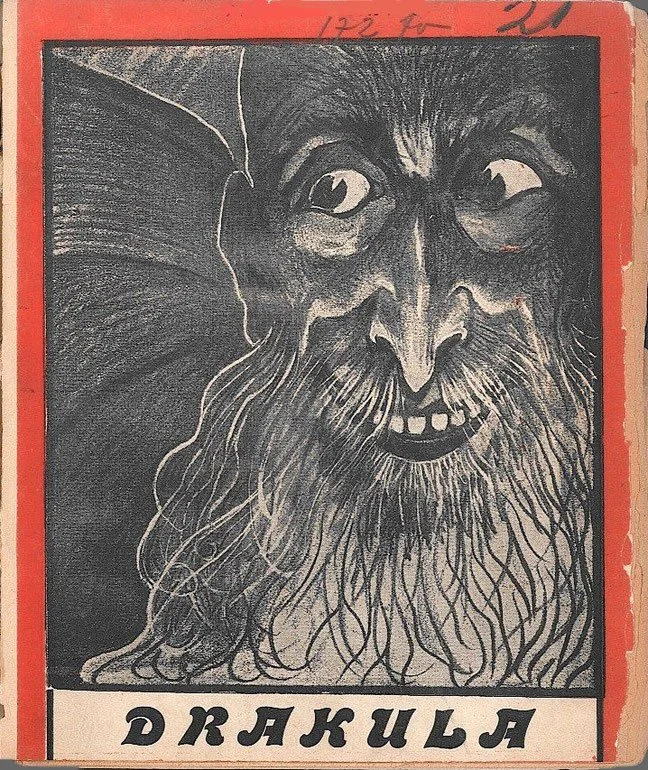
HZ: And a Hungarian translation published in 1898, with a cover illustration of the Count looking like he’s very excited to have dressed up as Rasputin for Halloween.
HANS CORNEEL DE ROOS: So someone got wind of the story, got hold of the book, and I think they just worked from the original text and spun their own modification of it.
HZ: One of the other sources of intrigue about Powers of Darkness is that they supposedly contains elements from Bram Stoker's unpublished early drafts of Dracula. But having studied various typescripts, Will Trimble rejects that theory.
WILL TRIMBLE: The inclusion of plot elements that appear in the unpublished drafts I find unconvincing, simply because there were a lot of things in his notes, and the vast majority of the things mentioned in his notes didn't appear here or anywhere else – werewolf ideas, volcano… The corrections that were made before the printing of Dracula, the typescript has hundreds of changes written in the margins, written by hand. And for a small part of those, you can recognise a part of Powers of Darkness that is relevant. And then the second half of Powers of Darkness wanders off from Dracula, and there aren't corresponding parts for half of the novel. But the first part of the novel, you can line some pieces up, and when you line the pieces up, they always match printed Dracula and never the draft of Dracula that was before the handwritten corrections. Never once.
HZ: Iris Ichishita:
IRIS ICHISHITA: If Bram Stoker was involved, or wrote Powers of Darkness himself, the evidence suggests that he would have written it after the 1897 Archibald Constable Edition.
There are edits in that 1897 version that appear in Powers of Darkness, which would suggest that either somebody else took that published version and then based Powers of Darkness on that, or that Bram Stoker, after having made those edits, then elaborated on his original work and made his extended version in Powers of Darkness. You can see the connections, the potential connections between his original development notes and what's in Powers of Darkness.
So it's not to say that those ideas might not have been kicking around from a very early stage, from the notes stage, but the idea that someone sat down to write this because of those edits, we know that it didn't predate the published version of Dracula.
HZ: How do you feel about the uncertainty of perhaps never knowing whether Bram Stoker did or did not write Powers of Darkness?
IRIS ICHISHITA: Um, God… I mean, I'm fine with it.
HZ: OK, good!
IRIS ICHISHITA: What is certain in life?
HZ: it's a great question. Certainty is a delusion that we like to feed ourselves, just so we can sleep at night.
IRIS ICHISHITA: I think so. I think so. I think that I would like to get closer to an author, right? I think that would be a great victory and a lot of people who following this mystery would sleep a little bit better, but, I guess I don't expect it immediately and – I don't know. It's also kind of the fun of it –
HZ: Endless, at the moment.
IRIS ICHISHITA: Yeah. Yeah. I mean, I get it. I can totally get if it drives you crazy – does it drive you crazy?
HZ: No. I don't care at all, actually. And I'm wondering what is wrong with me that I don't care at all. I'm like, “Fine.”
HZ: To clarify, it’s not that I don’t care about any of this, it’s that what I care about is not discovering who wrote Powers of Darkness or whether Bram Stoker had anything to do with that; and I don’t care about solving any of the mysteries around these books; the thing I care about is why other people care about this.
HZ: I thought, “What is wrong with you Helen, that you are incurious about who authored this?” But maybe it's just 'cause I feel like other people have got it handled more than I ever would. So it's just that
IRIS ICHISHITA: I think that there are lots of unsolved mysteries. More will be revealed.
HZ: Do you feel free now of Powers of Darkness? Or is it still busying away in your mind?
IRIS ICHISHITA: it's not forefront in my mind like it once was. but I think that Powers of Darkness will always occupy a space in my mind rent-free, and I will always be open to where the mystery takes us.
HZ: That’s Iris Ichishita, documentary producer and host of the Powers of Darkness podcast, and cohost with her brother Wesley of the podcast Or Whatever Movies. And we also heard from Will Trimble and Hans Corneel de Roos. The English translations they published of, respectively, the Swedish and Icelandic versions of Powers of Darkness are available now; you can even read Hans’s for free.
Next up is one more episode of the Draculae miniseries, oh go on then.
Your randomly selected word from the dictionary today is…
jeremiad, noun: a long, mournful complaint or lamentation; a list of woes.
Try using ‘jeremiad’ in an email today. “Are you around after work? I’ve got a proper jeremiad to get off my chest.”
This episode was produced by me, Helen Zaltzman, on the unceded ancestral and traditional territory of the xʷməθkʷəy̓əm (Musqueam), Sḵwx̱wú7mesh (Squamish), and səlilwətaɬ (Tsleil-Waututh) Nations. Thanks to Jeff Allen, and to Archer and Mars. The music is by singer and composer Martin Austwick; hear his songs via palebirdmusic.com and Bandcamp, and hear us on our long-running podcast Answer Me This. There are more than 400 episodes to get stuck into, if you want a gentle time that does not make you think or feel painful things.
Our ad partner is Multitude. To sponsor this show, whereby I will talk affectionately and persuasively about your product or thing, get in touch with them at multitudeshows.com/ads.
Find me on Instagram, Facebook, YouTube and Bluesky @allusionistshow.
Become a member of the Allusioverse at theallusionist.org/donate because even just a $2/month contribution is a big help to keep this independent podcast going. In return, you get stuff like livestreams where I read relaxingly from my collection of vintage reference books; you get membership of the Allusioverse Discord community to hang out with other podfriends; and you get bonus written content about each episode – after the last one, new Allusioverse member Peter commented these posts are “a delightful supplement to the episodes themselves. Bonus Zaltzmany goodness - hooray!” Thanks Peter, that’s the spirit! So you can donate, and also listen to or read every episode, get more information about the guests and topics therein, and see the full dictionary entries for the randomly selected words, all at the show’s forever home theallusionist.org.
