Go to theallusionist.org/park to listen to this episode, find out more information and see photos of the parks.
This is the Allusionist, in which I, Helen Zaltzman, rub language's back in the middle of the night to reassure it that there isn't a monster hiding under the bed. The monster is actually hiding in the sock drawer!
We’re deep into Four Letter Word Season, which so far covered the f-word, c-word, numerous four-letter words that don’t require censoring, and the scandal suffix -gate. Today’s four letter word is the noun ‘park’, which English got from Old French around 700 years ago, and back then it meant an enclosed piece of land for hunting. Now, though? A park can be so many things! It can be prefixed with words like car, retail, amusement, business, skate, theme, technology, water - and of course national, but the International Union for Conservation of Nature has made an official definition of national parks, although not all things called a national park fit that definition, and not all things that fit the definition are national parks. Still, it’s a lot less unstraightforward than the type of park I’m talking about today: the city park. Remember all the difficulty we have had in past episodes with definining what is a salad? (I don't even want to get into what is a pie or a cake - whenever you think you’ve got a working definition, along comes a Boston cream pie to ruin it.) Today we consider the taxonomy of park, the semantics of park: what is park?
You’ll find some photos of today’s excursions at theallusionist.org/park.
Before we go to the park, or several parks - or some parks that may officially be parks, but spiritually, are they parks? - I just want to tell you about cool stuff coming up. The first is IN one of Vancouver’s parks: we’re going to have a meetup at Spanish Banks Beach, on 13 August, from 6pm till sunset, you’re all welcome. More information is at theallusionist.org/events about that and the following: House band Martin Austwick and I made a radio version of our live piece Souvenirs, about two friends turning to enemies and fighting for the rest of their lives about a typeface. It’s very funny, and petty, and poignant, and it’s going to be broadcast on BBC Radio 4 on 22 July at 4pm UK time, and will be available online then too and for a little while after. We’ll have a live listening party in the Allusioverse Discord, so if you want in on that, become a member of the Allusioverse at theallusionist.org/donate. Also this month Allusioverse members are having a Four Letter Word Season watchalong of the 1999 Watergate comedy Dick, and the 2023 film Dicks: The Musical - yes, a double dick watchalong. Plus, we’re getting together to watch the new seasons of Great British Sewing Bee and Bake Off: The Professionals. Join us at theallusionist.org/donate.
On with the show.
CRAB PARK
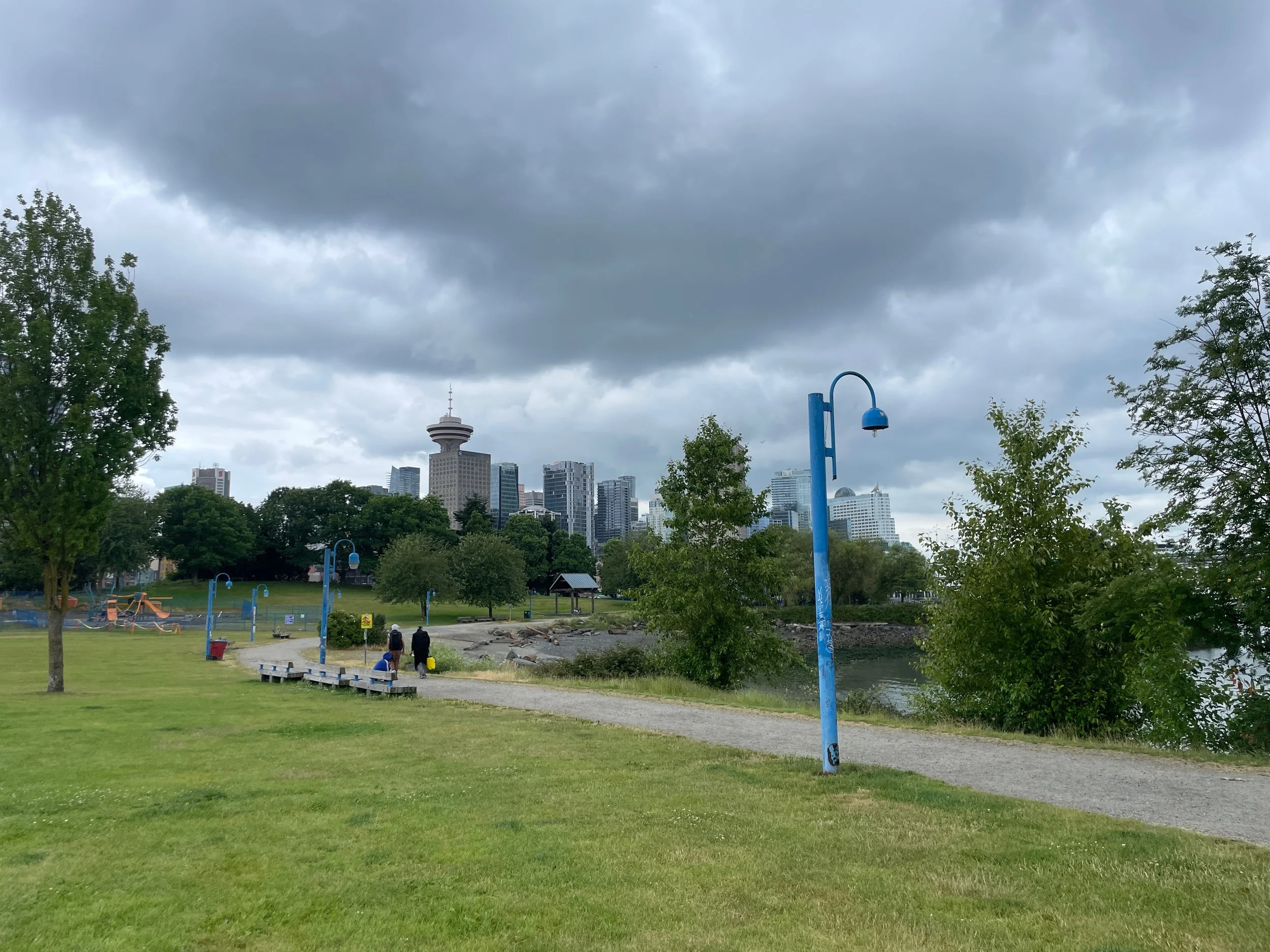
C.R.A.B. Park at Portside: over on the side of the park that isn’t the port is an expanse of grass, some trees, blue lampposts, a small playground, a grey beach and beyond the buildings of downtown Vancouver, perched atop one is the revolving restaurant.
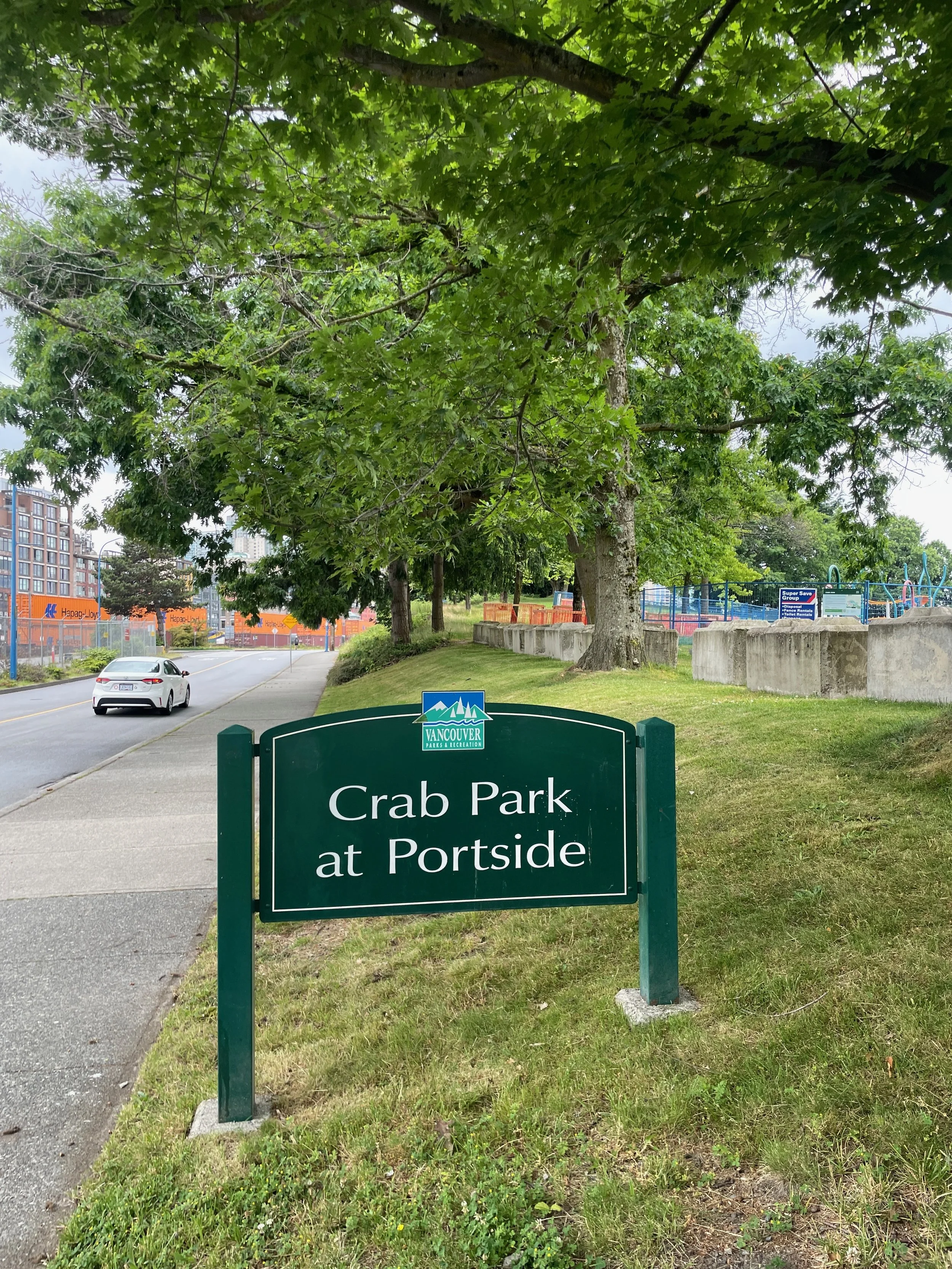
C.R.A.B. Park at Portside: on the edge of the park by the road is the park’s official green name sign from the parks board
HZ: Get in, winner; we're going on a field trip.
Do you have an umbrella? Because it’s drizzling. We’re in CRAB Park at Portside, where downtown Vancouver meets East Vancouver. There aren’t many public green spaces in this part of the city, but here are 400 metres of undulating lawn edged with trees, right on the shore of Vancouver harbour. The water laps at a small beach, the only beach in this part of the city; and looking across 2km of inlet, we see tree-covered mountains draped in moody clouds at the top and the buildings of North Vancouver at the bottom.
The park contains a small playground, a short pier, and a boulder engraved with a memorial to missing and murdered people from the Downtown Eastside, many of whom were indigenous women. To the park’s downtown side, there are tall shiny buildings, the revolving restaurant, cruise ships parked up for the day; on the other side there’s the port, with stacks of multicoloured containers being loaded on and off ships and trains, loomed over by big red cranes. The park is not the easiest to get to, bracketed on one side by railway lines and the other by water, but right next to it is a helipad, so I suppose that’s an option for… some people? Who are unlikely to be listening to this?
This is my first time at CRAB Park, and we're here meeting someone who has visited not only this park, but every single one of Vancouver's parks, and scored them on several criteria to create an overall ranking. CRAB park came 66th overall - not bad.
JUSTIN McELROY: My name is Justin McElroy. I am the Municipal Affairs Reporter for CBC Vancouver, and I am the owner and proprietor of VancouverParkGuide.ca, a ranking of all 243 parks in the city of Vancouver.
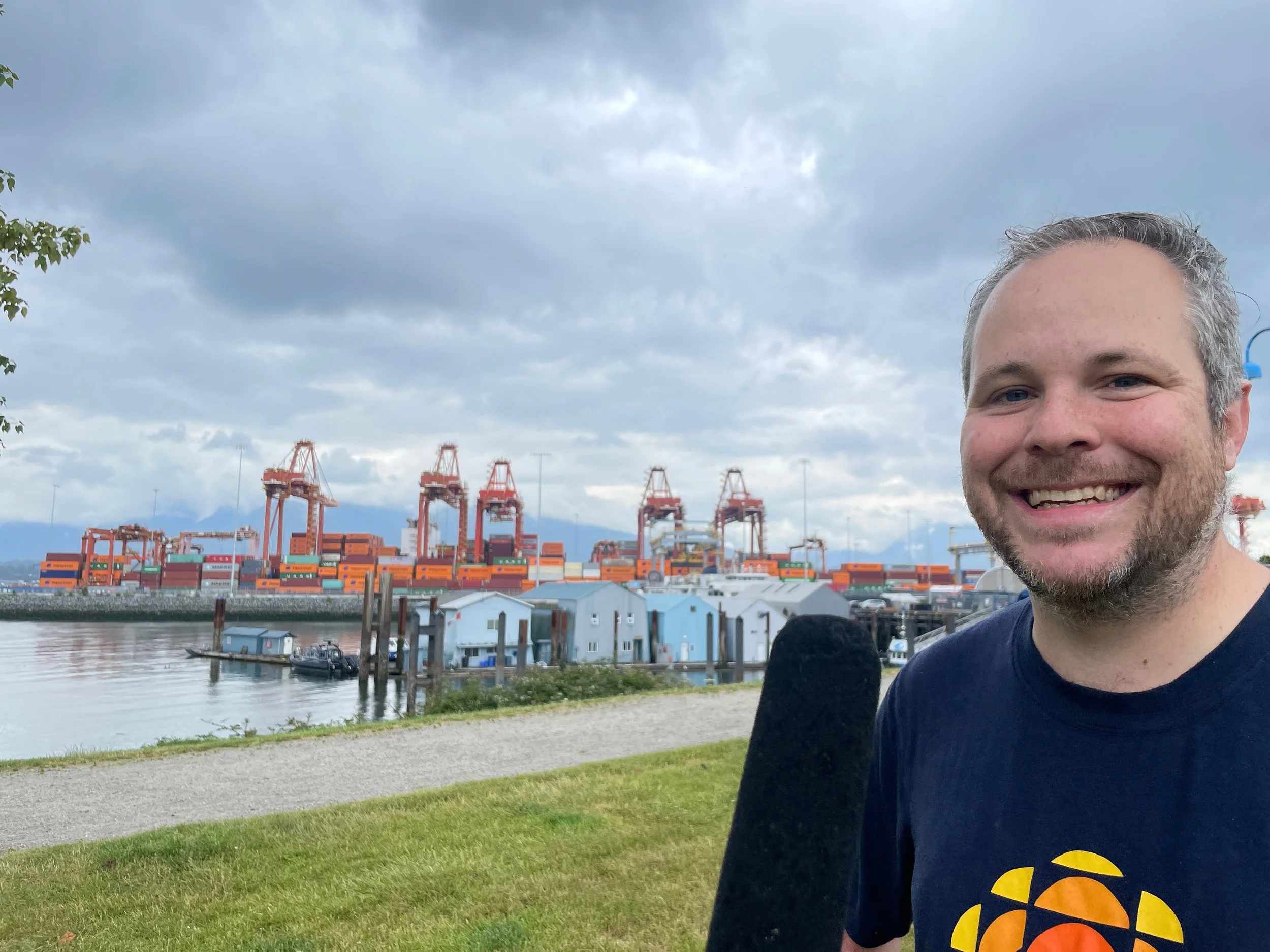
C.R.A.B. Park at Portside: Justin McElroy stands in the rainy park while Helen waves a microphone in his face. Behind Justin is the port, with large cranes and stacks of shipping containers.
It began sort of during the pandemic, actually the very beginning of it where we're all told like, “Don't do things in groups, but you can be outside.” And we had been thinking about what are things we can do as friends in these unprecedented times, as we all called it, in April and May of 2020? And I went, well, I've sort of joked for years, somebody needs to rank every park in the city. The more I thought about it, the more I was like, oh, this is the one time where this project could actually happen. There are 23 or 24 neighbourhoods in Vancouver. And for six months we picked a different neighbourhood each week and we would walk from park to park and explore the neighbourhood, and then we would spend at each park anywhere between like 20 minutes to a couple hours, depending on how much fun it was, and sort of explore it. So we would go on the playgrounds, we would walk around and point out: “Ooh, that's a nice bevel,” or “Oh, this is a sturdy seating area,” or “This slide has seen better days.” And then maybe have a cheeky beverage or get a snack somewhere, and relax. And then okay, onto the next one. And we just did that time and time again for 23, 24 weeks, and voila, you have a score for all 243 or so odd parks in the city.
So there's four things we score a park on: 10 points for kids, 10 points for adults, 10 points for design, and 10 points for X factor: all the things coming together that you just can't quite place your finger on, but you're like, "This is a great park."
The joy of something like this is treating something very mundane very seriously, and then allowing the the things you find out about it with the rest of the world and finding out, oh, people would actually love knowing what the 10 best parks for children are in the city based on this very elaborate and silly scoring metric.
HZ: You say silly.
JUSTIN McELROY: Yeah, I mean, it can be serious, right? And certainly there's a lot of work that goes into what makes a good park and what makes a good playground. But I think the silliness comes from the joy of a good park, particularly if you're a kid, is that you just forget about the world and you're enjoying playing and you're enjoying being in the moment. And so there's an inherent silliness trying to quantify that in a numerical way for 243 parks across the city.
HZ: 243!
JUSTIN McELROY: As of 2022 - I've taken a couple years off of not updating, but what is interesting is when a city creates a new neighbourhood, you create new parks for it as well.
HZ: Before you embarked upon this project, did you have an idea that there were so many parks?
JUSTIN McELROY: I didn't know there were that many. And part of the funny thing about Vancouver is there's probably like 50 capital-P Parks that everyone thinks of; then you have endless sort of sports fields with a playground that are sort of parks; then you have sort of weird medians in the middle of the street which are also weirdly parks sometimes. Part of it was we knew what the best park in the city was gonna be, because Stanley Park is self-evidently amazing; but we didn't know what the worst park would be, and we didn't know what the second best park would be. And so that was the joy of discovering on both the high end and low end of things, just how good or bad something that is city designates a park can be, because you can name anything a park.
HZ: And they clearly have.
JUSTIN McELROY: And they clearly have. And then it's protected, and there's legal things that go around with it, both in terms of what can happen on it, the oversight of it - because we have a separately elected park board in the city, though maybe not for much longer. But once it's established, there's no minimum standard of what it has to have. So some parks have playgrounds and they have washroom and they have seating facilities and they have a clear entry point and there's multiple different things to do in them. And some of them are just patches of grass on a weird angle where the lawn hasn't been mowed in months and there's flies everywhere and there's a sad, empty tennis court that's sort of decaying and you go, why does this exist?
HZ: Well, it maybe encourages you to retreat to the park of the mind.
JUSTIN McELROY: That's a very zen and positive way of looking at it.
HZ: I'm trying, because I feel like some of the parks that we're going to go to are going to test my parameters of what I consider park.
JUSTIN McELROY: The thing is, in every park, you can see the potential, right? And you could see the hope and what it is going for. The difference between dream and execution is manifest in so many parts of city life, but when it's a park, a very self-contained physical space, it is very neat to explore that gap in potential.
HZ: How difficult is it to declare something a park? Because you said once it's a park, then the parks board currently supervises.
JUSTIN McELROY: Yeah. Then it's protected. Then, it cannot be removed from being a park without, I think it's a two thirds vote of both the park board and city council. And so the backstory for a lot of parks in the city is the result of weird negotiations where people want more green space; other people want something else, a redevelopment perhaps, or a rezoning or to get the city to move on something: and oftentimes, the park is a compromise of all these competing pressures. The park that we're in right now, CRAB Park, the acronym - it's not actually crab the animal that it stands for; Create a Real Available Beach is what CRAB Park actually stands for. And that was the name of the committee that tried to push the city to create a real available beach in the downtown area that’s in the northeast side. And so this is the end result of that. The beach itself is not really beachy, right?
HZ: It's technically real and accessible. Just like the acronym.
JUSTIN McELROY: Yes. They didn't say create a real and available, awesome, sandy, beach,
HZ: There’s some sand! Underneath all those sharp pebbles.
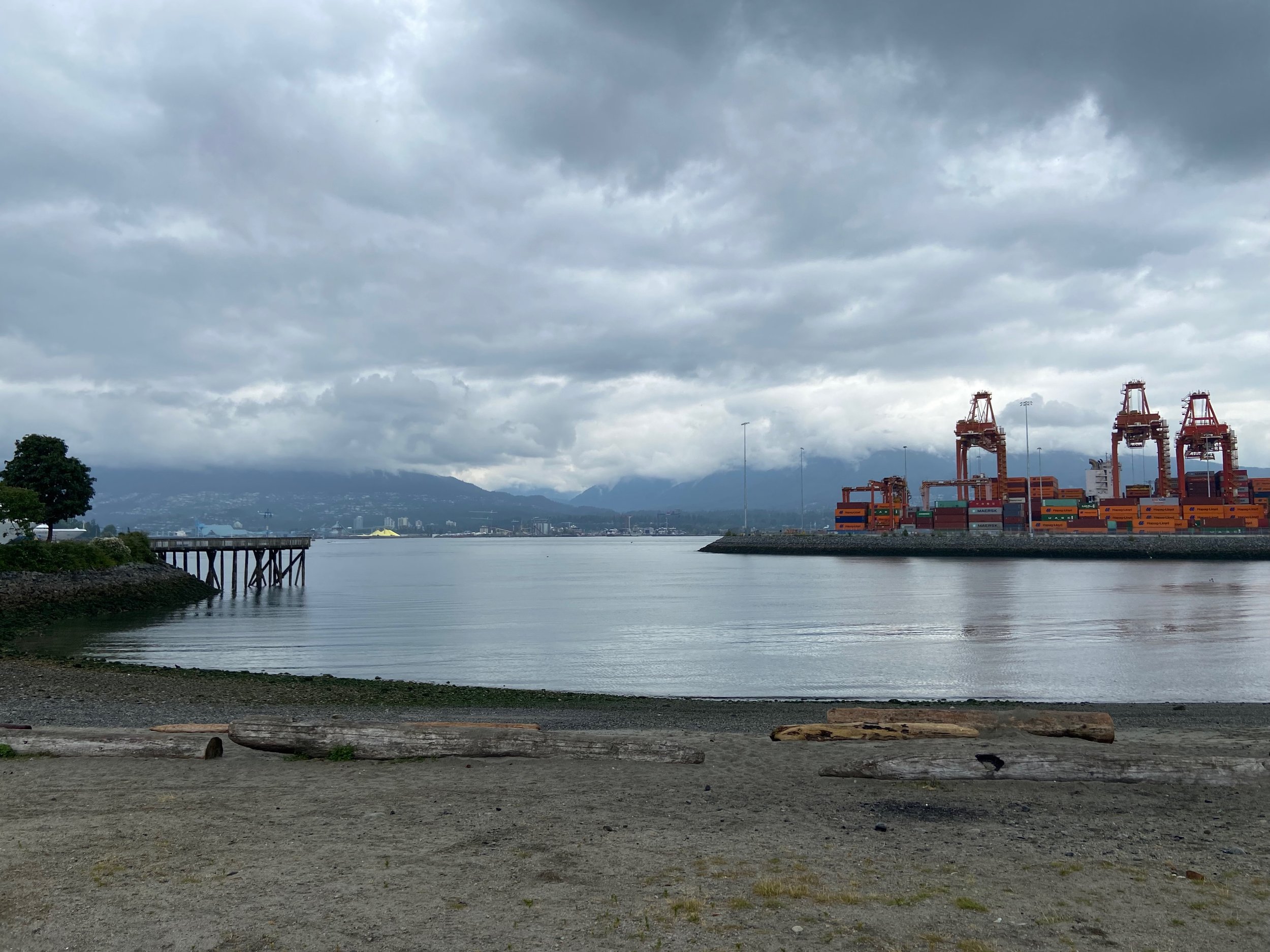
The log-strewn beach at CRAB Park, looking out over the Vancouver Port to the shipping containers and cranes, and beyond that the mountains of North Vancouver under intense cloud.
JUSTIN McELROY: But, like you get the effect of, oh, I could go in the water if I wanted to. You see more dogs than humans take advantage of that. But, it's still like, there's the potential, right? And one thing that makes a good park in my mind is the thought of, “Look at all the things that I could do, or we could do. I'm not gonna go into the water today, but there's that potential.” It's a lovely thing for the community and has been used in all sorts of ways over the years, controversial and not.
HZ: One of the controversies has been over CRAB Park’s legal encampment for people experiencing houselessness, established in 2021 and at the time the only legal encampment remaining in Vancouver. It was home to around 150 people for a while, but the city government shrank it and shrank it, added extra restrictions such as forbidding modifications to protect tents when it rains (which it does here very often, including while Justin and I are standing here talking) - and then in late 2024 they closed down the encampment entirely. The encampment’s residents lost their community and their place, and many other locals weren’t happy either, saying they had not been consulted about it, and would prefer the city spent the money not on clearing tents and destroying people’s belongings, but on facilities and amenities for people experiencing houselessness. Forbidding people to live in this place doesn’t magically create another place for them to be.
JUSTIN McELROY: And this is the constant debate in this city. I'm a city politics journalist in my day job, because you can't be a park ranker 24/7 -
HZ: Aw!
JUSTIN McELROY: Very sad - but it is the constant. People gather somewhere, whether a street or a park; the city says, “We're disbanding this,” and people go, “Well, where are we supposed to go?” And that's always been a tension point in Vancouver. It's grown over the last 10, 15 years, as affordability issues have gotten more and more intense. And parks end up becoming the focal point for a lot of those tensions, because they are a public space - but a public space for whom, and under what circumstances, is always something that is contested.
HZ: Yeah. I think to be in Vancouver is constantly to be aware of tensions over the land, because it's stolen land, also.
JUSTIN McELROY: And it's amazingly beautiful land, and it is home to some of the most amazing sites in the world, and incredible luxury, and also some of the most highly concentrated scenes of poverty and degradation in all of North America. And that is a contrast that you live with every day.
HZ: CRAB Park’s name is a reminder of local people’s successful action to persuade the city to turn this area, which in the early 1980s was landfill leased by the port, into green space for the public to use.
HZ: I was wondering whether the acronym CRAB being quite catchy had sort of helped in the campaign, because I think they started the campaign in 1982. And the park was achieved in 1987. But if they just said, “Make a park please,” and didn't really have a slogan, then I wonder if…
JUSTIN McELROY: The slogan adds like a 7% extra chance of it happening. But like I think there's, this is the nub of politics. There's all sorts of people that want things to happen. How do you convince the powers that be to get behind it? How do you convince enough people in your community to care about it, to add to your coalition? There's a reason every politician tries to have a catchy slogan or interesting signage because these things matter in creating a movement.
HZ: It was named after the movement in 2004, so it'd been called something else in the meantime.
JUSTIN McELROY: Oh, it was Portside Park.
HZ: Portside Park, which is a truthful name: it's at the side of a port.
JUSTIN McELROY: And don't quote me on this, but like, it was 2004 and that was when we had a very left wing progressive party in power in Vancouver. And so it may well have been that, they went, "We want to create more sort of linkages to places where people power had a real impact in shaping the city." And Portside is very generic of a name. It's accurate, but it doesn't sing. CRAB Park is spiky, by its nature, in what you think about, but it tells the story and that's sort of cool.
HZ: Yeah, I think maybe they could make a little more of the crab iconography, both acronym and non-acronym.
JUSTIN McELROY: I mean, bluntly missed opportunity with the playground. Like you could have some sort of crab-shaped slide. But you know, one can always look at what a city government does and say, “You could have been a little bit more artsy or creative.”
HZ: Or crabby.
JUSTIN McELROY: “Or crabby. And instead you just did something sort of nice and generic.”
HZ: Maybe they were like, "It's misleading to put crab stuff here, because it's not about crabs." Somebody goes, “It needs to link back to the original committee, not the crustacean.”
Should we go to our next park assignment?
JUSTIN McELROY: Absolutely. What a fantastic phrase to hear.
Trout Lake
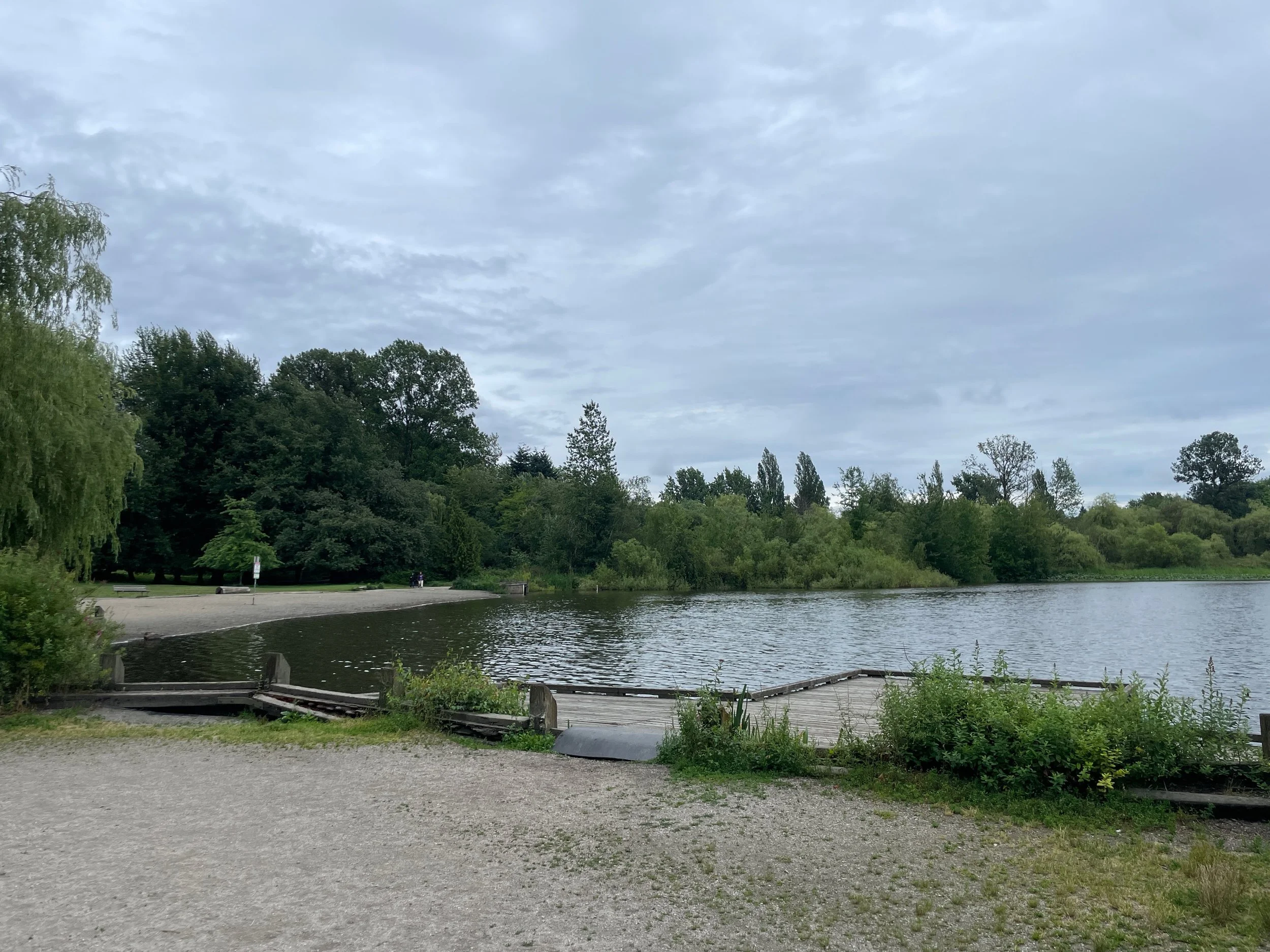
John Hendry Park's Trout Lake, edged by trees and shrubs, with a little beach at the north end and a small wooden jetty.
HZ: Okay, Justin, let's paint a picture with words. Where are we?
JUSTIN McELROY: We are at John Hendry Park, or as it's better known, Trout Lake. We are looking at the trout lake, the lake in the middle of the park. You've got a bit of marshy bits, on the wide sides of it and on the far ends. On the north end, you have sort of like a gravelly dog area, and on the south end you have sort of a beach with a couple of logs. If it is a nice warm day, you will see a lot of people on the beach; you won't see them swimming generally because the E. coli levels are incredibly high.
HZ: How enchanting. “Oh, because they'll get driven up by a trout?” “No, it's the E. coli.”
JUSTIN McELROY: It is the Vancouver story. What a lovely thing to look at! Actually engaging with it: maybe yes, maybe no. And you will see all sorts of families, you will see people jogging around the perimeter of the lake. You will see in the summertime, a farmer's market that is beloved by every East Van hipster. It is beautiful place where so many people can do so many different things, which is why we rated it the second best park in the city.
HZ: Nice choice. There's some absolutely magnificent trees with really mossy trunks, because we are in a rainforest. There's lots of different areas to sit if you want sun or shade. I like the fact that there's these different textures. We are sitting on a kind of wooden...
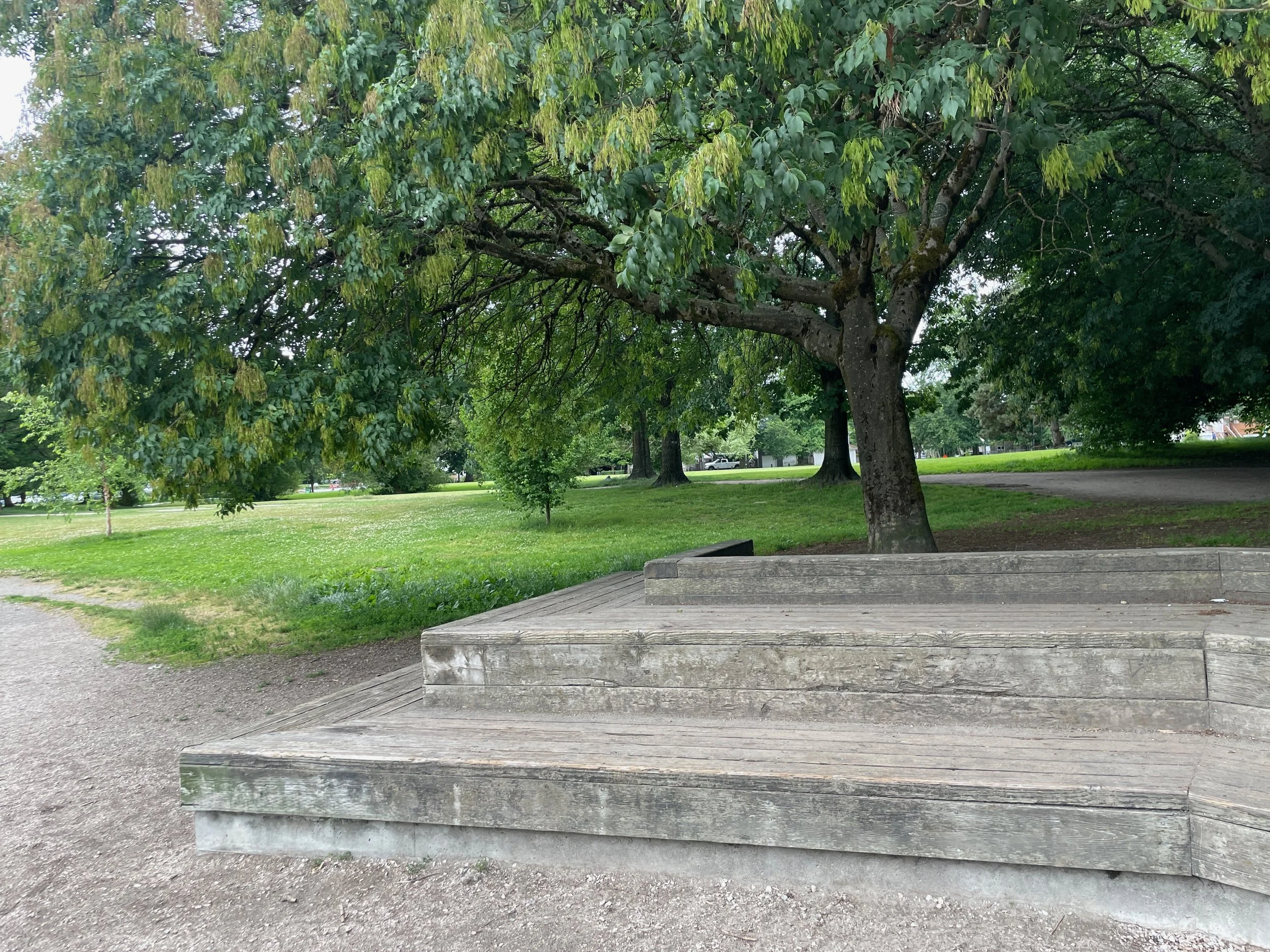
In John Hendry Park, overlooking Trout Lake and under mature leafy trees, is a three-tier wooden seat
JUSTIN McELROY: Sort of mini amphitheater. You could imagine a busker here playing, or like kids putting on a cute little show -
HZ: About the dangers of E. coli.
JUSTIN McELROY: Naturally. Like it allows public spaces to have organic things happening that aren't prescribed, right? Which is a tough combination to actually pull off. Everyone talks about creating a place like that. And we'll go to some parks today that do not do that. But here, it happens, and part of it is because so many people use this park. And part of it is just they were very smart in terms of the little things they created, like this mini amphitheater, like that sort of barge that goes a little bit out into the lake in front of us, that make it a pretty magical part of the city.
HZ: I don't think I have ever heard someone refer to this place by its formal government named John Hendry Park. I've only ever heard them talk about Trout Lake.
JUSTIN McELROY: It's such a generic, but like difficult to say name. “John Hendry” doesn't evoke anything sort of like beautiful or, with apologies to any John Hendrys out there, but where you go oh this is a community gathering space in the same way But John Hendry was a man who owned one of those sawmills that defined the early history of Vancouver's industry. And when he died, he basically bequeathed to the city, through his daughter, this land on the condition that part of it be made a park and it be named after him. And the city said, "Great!" Basically, it was named that, but you look back at old newspaper clippings and it very quickly became just called Trout Lake for the trout that used to live here, back when the waterways of Vancouver were much more thriving and plentiful and had not been mostly developed over. Very little fishing goes on here today. But Trout Lake is a fun name.
HZ: ‘Trout’ is a satisfying word.
JUSTIN McELROY: ‘Trout’ is a satisfying word; it's a plucky word as well, it has an East Van spirit to it; and so it evokes an image which is visual and pleasing in a way that John Hendry sounds like - it sounds like a bank, it sounds like an accountant, it sounds like a lawyer. And those are all good and necessary things for a city to have but it does not sound like a park.
HZ: Thought-provoking really that it's named after a man that probably most people don't even know the name or know who he was, and they refer to it after a fish that is no longer present.
JUSTIN McELROY: This is the part of why things are named. And a hundred years ago there would've been lots of people that went, “Yeah, that was a very prominent business person of the time.” A lot of things in Vancouver are named for this very short period of 20 to 30 years when the city was settled, when the railway came in and hundreds of thousands of people came here, and what was formerly both indigenous lands and just lots of forests that wasn't really used got all developed, and you suddenly had to name everything. So many things in this city, you go, "Why is it named that?" It's like, well, they were a sort of prominent person, as a councillor or a business person or involved with the railway in 1910 and so forever more they will be memorialized.
HZ: I've done quite a lot of work about eponyms, and that has made me come to the opinion that there should be a statute of limitations on how long a place can be named after a person.
JUSTIN McELROY: Yeah. Term limits, right? You get 50 years. Things aren't renamed for all sorts of reasons, generally. And one of them is, it's quite expensive because you think of all the different groups that use a name and the amount of time it takes for all of them to change the input and how they use it. It is not a non-zero cost. Which is why, when folks say we need names that reflect what a place is today and not 200 years ago, the default thing to do is to create new lanes - when you're creating a new street or a new lane or a new park or something, that's where you implant it with the culture and history of today and allows that balancing to happen. But the benefit of trouts and Trout Lake is people will still love trouts a hundred years from now. 200 years from now, trouts won't become problematic. Trouts won't get canceled - probably.
HZ: We don't know!
JUSTIN McELROY: We don't know!
HZ: What if the E. coli has strengthened them, and they take to land and start biting people?
JUSTIN McELROY: Mega Trout Park.
HZ: Yeah, well, then we'd be too afraid not to call it that.
JUSTIN McELROY: Yeah.
HZ: And we'll go to some other parks where really the public will has prevailed over the name.
JUSTIN McELROY: Yeah. In case this is an example of this as well, if people loved John Hendry - and, for the record, there doesn't appear to be anything quote unquote “bad” that John Hendry did.
HZ: This is a rich business dude.
JUSTIN McELROY: Yeah. But if he was really, really beloved, then maybe that name would have prevailed over the years. But very quickly people went, “Nah, this is Trout Lake. That's the name of the park.”
HZ: Yeah, I like that there's some other parks named after people that people want to pay a tribute to, it wasn't just that they had the money to own the land, where it's like the first archivist -
JUSTIN McELROY: Major Matthews, yeah.
HZ: - or the first Black politician in BC -
JUSTIN McELROY: Rosemary Brown.
HZ: Rosemary Brown, that's right. Yes. That's cool.
JUSTIN McELROY: Yeah. And these are little ways that, you know, we acknowledge people and it reflects the times. When some people say dismissively, “Oh, this is all named for old, white, Scottish settlers,” it's like, well, yeah, that was a key part of Vancouver's history and integral to how the city became what it is. The question is: how do you reflect that while also reflecting every other part of how Vancouver is now and was before? And that becomes a little bit tricky just through the dint of you named everything at once and now there is very little else to be named.
HZ: Also, I think if there was less of that in the naming, people would still remember the colonial history; but because that is such a dominant naming trend, it does blot out so much of the other history.
JUSTIN McELROY: It just limits the opportunities.
Dude Chilling Park
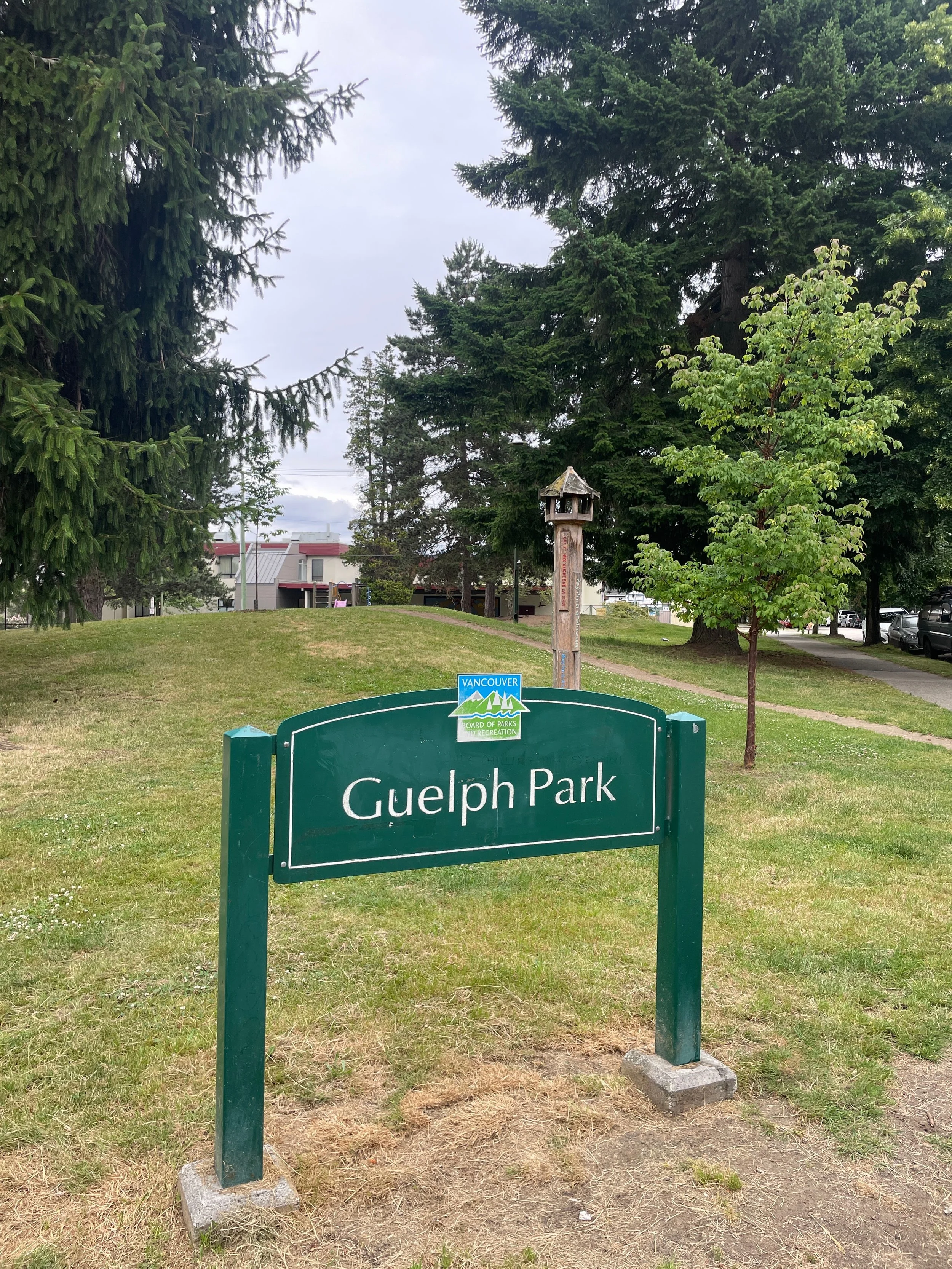
The official parks board sign for Guelph Park. Who??
HZ: Quick location change...
HZ: Speaking of parks that aren't really called by their official names. Where are we now?
JUSTIN McELROY: We are in Guelph Park.
HZ: No, we are not.
JUSTIN McELROY: We are in Dude Chilling Park.
HZ: That's better.
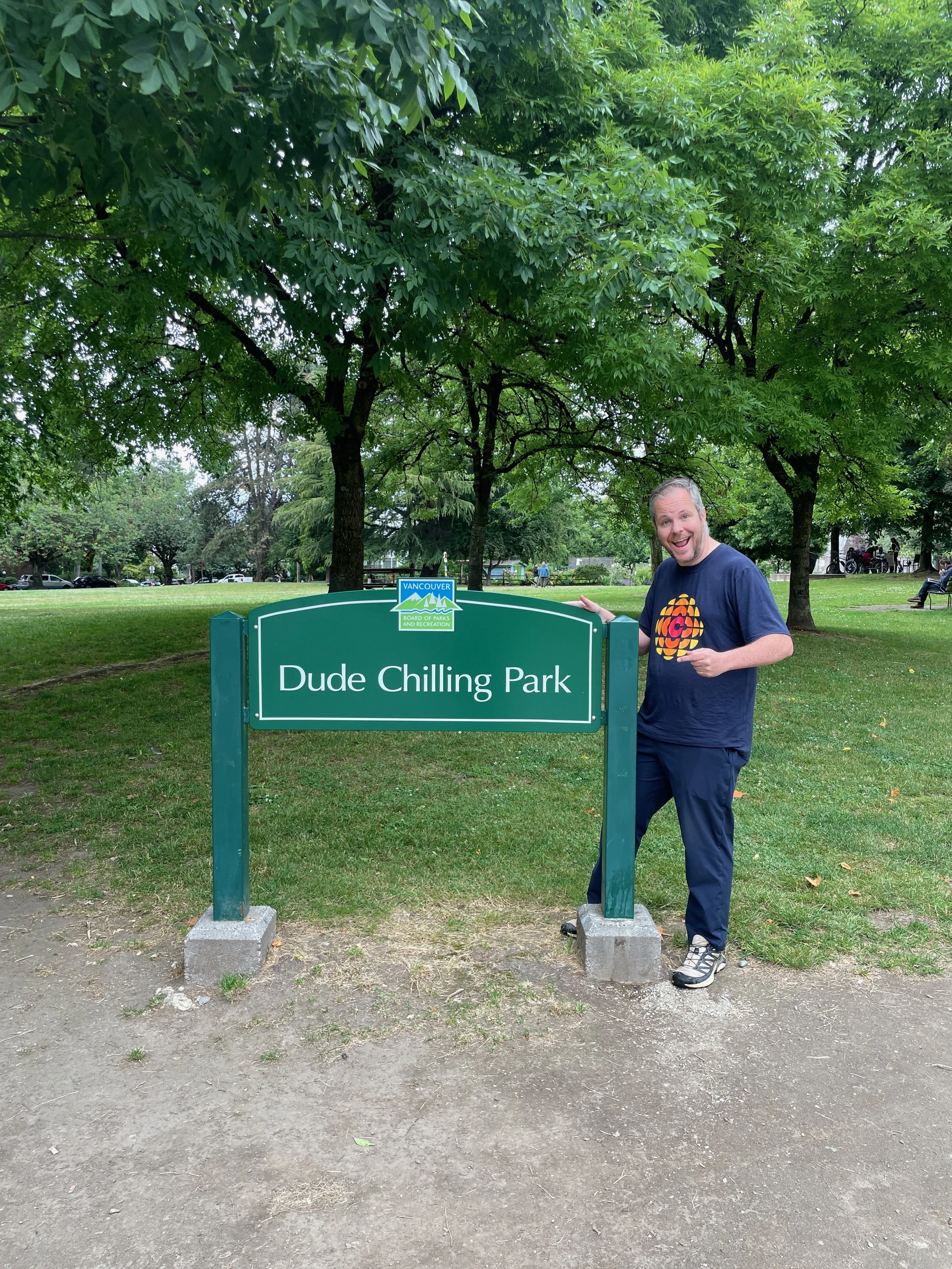
That’s better - the Dude Chilling Park sign, with a Justin McElroy being a dude chilling next to it.
JUSTIN McELROY: Every name has a fun backstory. And Dude Chilling’s is more amusing than most. So we're walking towards this sculpture of what appears to be a couple pieces of wood shaped in a way that looks like a person sort of relaxing on a particularly comfy sort of log or contraption of some sort.
HZ: Oh, that's what you're seeing? I'm seeing sort of a person who's striking a pose a bit like that famous nude picture of Bert Reynolds.
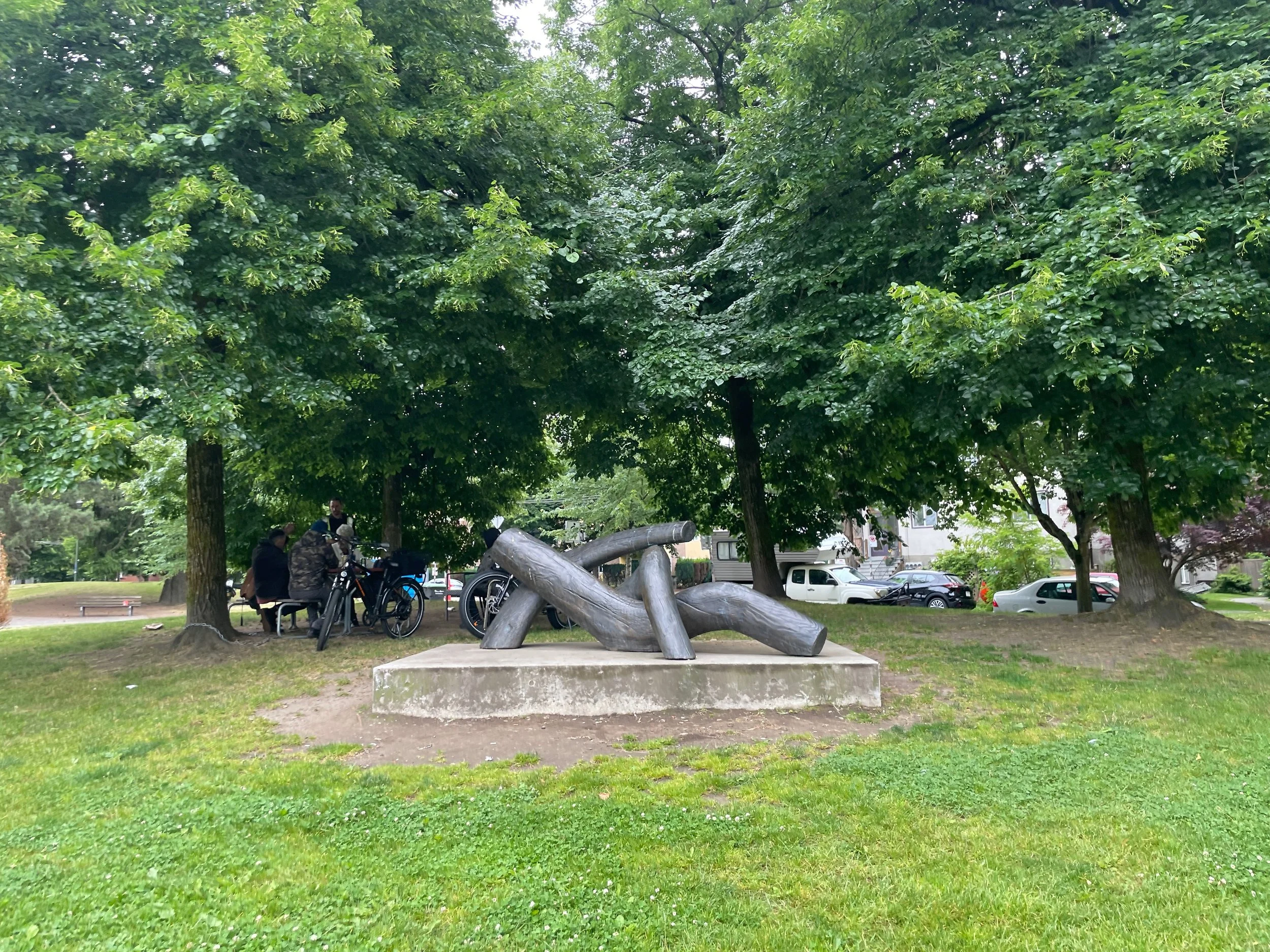
The original Dude Chilling: the sculpture Reclining Figure by Michael Duncan, under trees in Guelph Park. It is a slightly larger than human size abstract figure, reclining in a sassy pose, one leg flung over the other. It looks like it is made of long bent logs, but the original wood has been replaced with a bronze version.
JUSTIN McELROY: Oh! It is called Reclining Figure. and it was done by a local artist -
HZ: - Michael Dennis -
JUSTIN McELROY: - in 1991, in what is, again, Guelph Park. Guelph Park, named for Guelph Street, which it is just next to Guelph Street, named in honour of the royals by the city - because again, Vancouver was really settled, exploded in population, late 1800s, early 1900s. It's a really big focus on the Edwardian and Victorian morals and ideas and nationalism and patriotism. And so we have lots of things named for certain royal eras in Britain.
HZ: Now, I think if this was just called Guelph Park, this would not be Vancouver's second most well-known park internationally - because I mean, it's nice. It's a couple of city blocks. It's grassy, it's got some trees, it's got a tennis court, it's got some slides.
JUSTIN McELROY: Yeah, it is -
HZ: But it's a regular neighbourhood park.
JUSTIN McELROY: It is a regular neighbourhood park that I ranked sort of middling, in the sixties or seventies, in terms of Vancouver's best park. Because there's plenty of places that are like this, where you have some trees, you have grass that is sort of uneven, you can use for picnics or playing, but it's sort of not really ideal for either; you have a community garden; you have sort of a middling playground and a couple of tennis courts. It's perfectly cromulent. But, everything that it does, there are better places to do it, even within the Mount Pleasant neighbourhood. But what happened is, about a decade or so ago, somebody decided to put a cheeky sign up at one of the corners.
HZ: Artist Viktor Briestensky.
JUSTIN McELROY: Put up a sign that looked like a typical city of Vancouver Park sign, but instead of saying “Guelph Park”, it said “Dude Chilling Park”. People were amused by it. And then it became a Streisand Effect situation where the parks board took down the sign because they're like, "That's not the name of this park. This will confuse people. This is Guelph Park. And that's that." But both because people fully understood what it meant as an homage to the reclining figure, who could very well be a dude chilling, so it fit the motif and it fit what lots of people like to do here, and we can see them right now - there's just a few dudes chilling over there. And so people became quite taken with it. I think Jimmy Kimmel did a short little segment about the city trying to like clamp down on fun with this.
And the city realized at a certain point, "Ooh, this would be good PR or the park board if we said that the sign gets to stay and this is now unofficially Dude Chilling Park.” But again, as we've talked about, changing the name of something legally actually takes a little bit of time and money. And the city, historically, has not been keen on that. So it is still called officially Guelph Park. There is a sign that says Guelph Park on the other side of the park that is less trafficked, but at the southwest corner of it, it says Dude Chilling Park. It's an official city sign, even though it's not the official name.
HZ: In a way, then, they got the best of both worlds because the park got a better name, and the parks board didn't have to do anything financially to change the name properly.
JUSTIN McELROY: It was one of those rare moments where a government realizes they have an easy win and they take it. And even though, you know, it started from them being silly with taking down the sign in some ways, and is a small example of how governments can be responsive to people and make them say, "Oh, I guess this like city isn't all bad after all."
HZ: A rare example of democracy.
JUSTIN McELROY: A rare example of democracy. And one of those things that in the years after that, as the price of homes throughout the city continued to explode and governments really didn't do a heck of a lot about it until it was too late and then got voted out, the original enthusiasm for the name and spirit of coming together may have been dimmed somewhat. However, this is still a place where dudes chill and is an evocative name for what, at the end of the day, is a pretty standard park.
HZ: To me, the sculpture looks like a dude posing. “Dude Posing Park” though probably wouldn't have taken off in the same way.
JUSTIN McELROY: No. Posing is sort of like a selfish egotism act, right? Chilling is a lovely communal feeling.
HZ: Where to next: Dusty Greenwell Park, named after community activist Dusty Greenwell? Pandora Park, named after a street named after a ship named after the HMS Pandora which sank on an expedition to capture the crew who had mutinied on the Bounty? Slidey Slides Park, a name coined by the kids at the local childcare centre after slides being slidey?
No, next I make Justin visit one of his lowest-ranked parks, Sun Hop Park, which is a slender triangle tucked into a slight bend on Main Street.
Sun Hop Park
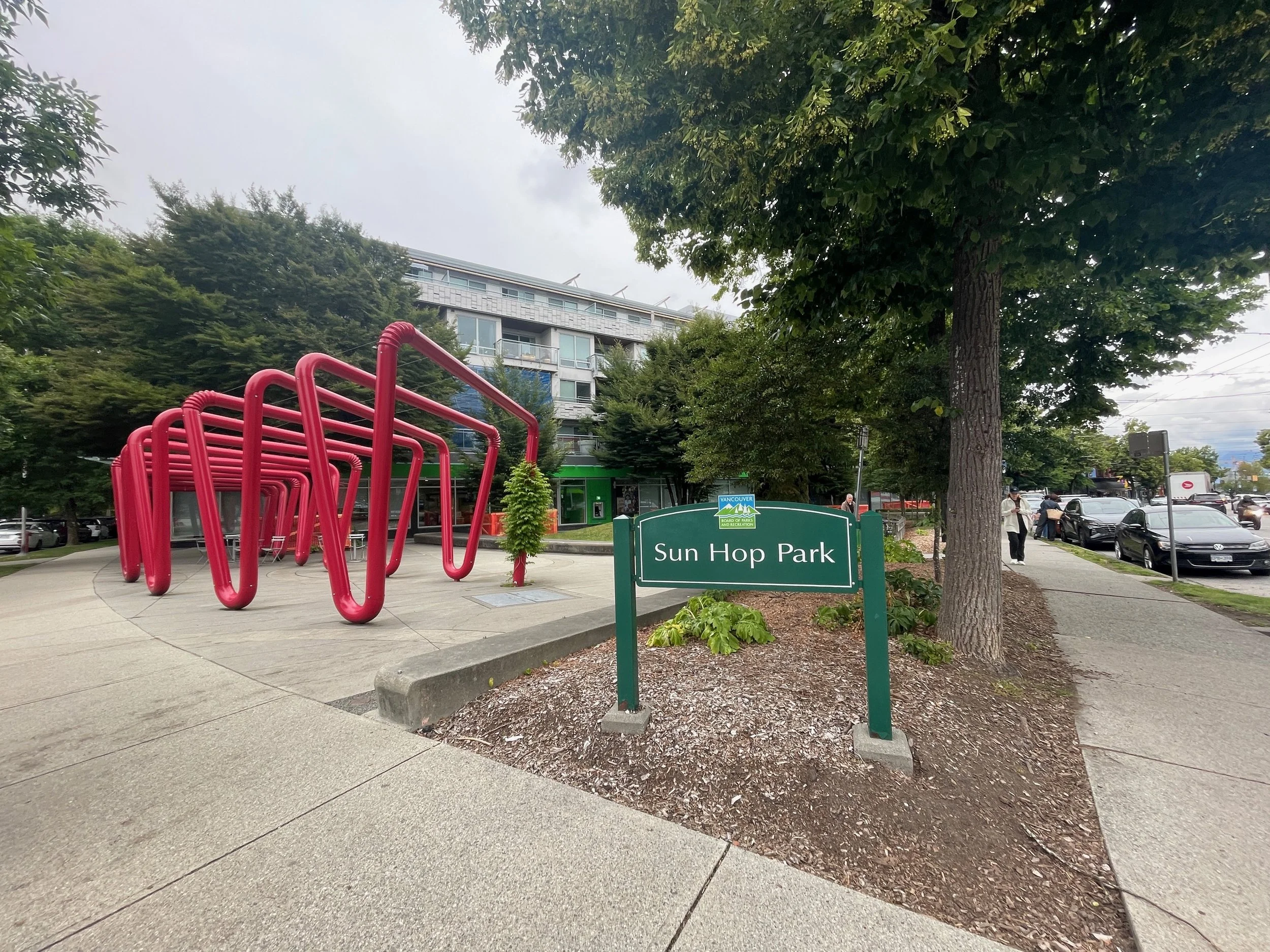
Sun Hop Park, on the intersection of Main Street and 18th Avenue. In a sparsely planted flowerbed with a few trees in it, there stands the green sign with the name of the park, next to it the installation of giant red bendy straws, and behind it the bank.
HZ: Okay. Justin, where we are is somewhat testing my definition of 'park', because you could see it as just an expanded sidewalk.
JUSTIN McELROY: Yeah. I think this would expand most people's definition of park, because it is on a busy street. It's just sort of like a fifth of a block that is an extended front area for a bank and a four-storey apartment. The only bit of grass is this weird quasi -
HZ: Hump?
JUSTIN McELROY: - hump, hill, that we're sitting right in front of. The rest of it is concrete. There's only a couple tiny chairs and tables. It is not a place that you would think of as a park in either the greenery sense or a place to hang out in.
HZ: Why is it a park then?
JUSTIN McELROY: Because it's park land. So this is an area that the city of Vancouver went - we are in Mount Pleasant, we are on Main Street, a very busy place - and they said there should be a park here for everyone that either lives on Main Street or works here, has a lot of mid-rise apartments. Or people that work or play around the area. And we've identified this parcel of land that we own. So we are going to call it a park, and we're going to make it a park. And about a decade ago or so, they went through an extensive process to actually make this a park. They spent about $500,000. They consulted everyone around in terms of what they would want for a space like this. They decided that they would name it after a grocer from the 1920s to pay homage to the Chinese greengrocers that set up shop in this area.
HZ: Sun Hop. Although it was originally called Mid Main Park, which is such a unimaginative name.
JUSTIN McELROY: Because it was in the middle of Main Street. But there was so much good intent in this park, and yet immediately it was very obvious that it wasn't working, because we are sitting here right now and do you see anyone else?
HZ: Well, it's a Friday afternoon. People are at work, they're not at leisure yet. They can't just be hanging around in Sun Hop Park.
JUSTIN McELROY: But we saw people in Dude Chilling Park. We saw people at Trout Lake - CRAB Park, not so much - but like the idea of a park is you want to activate public space for people to enjoy for all sorts of reasons. And people do not enjoy this park, because there are so little obvious reasons why you would do so.
HZ: I enjoy it as an expanded sidewalk. As a park, I wouldn't linger here; but as a sidewalk, I'm like, “Oh, how delightful.” There's an installation that is like a giant red bendy straw. There are all these allusions to it having had a milk bar on this premises some time ago.
JUSTIN McELROY: Well, and so that's part of the thing is parks, you want the purpose of things to be very intuitive to people: this is where I hang out. This is where I sit. This is where things can happen. This is what this sort of art is for.
HZ: This is where we celebrate dead milk bars. And there's all these like bubble shapes in the paving there are these like little stools that look very uncomfortable to sit on, but are like the counter stools at a diner or something.
JUSTIN McELROY: And so if you're told that, it's like, "Ah, yeah, cool, I get it. There you go." But if you don't get it immediately and it doesn't look like a comfortable place to hang out, then you're not gonna sit around and explore and find out. And so therefore it's nullifying the entire purpose of why you would want to create a public space in the first place.
HZ: But for such a tiny public space, they have packed it full of strange. Because of the straws, but also there's a column which I'd estimate is what, three storeys high, and there is a large statue of a poodle on it.
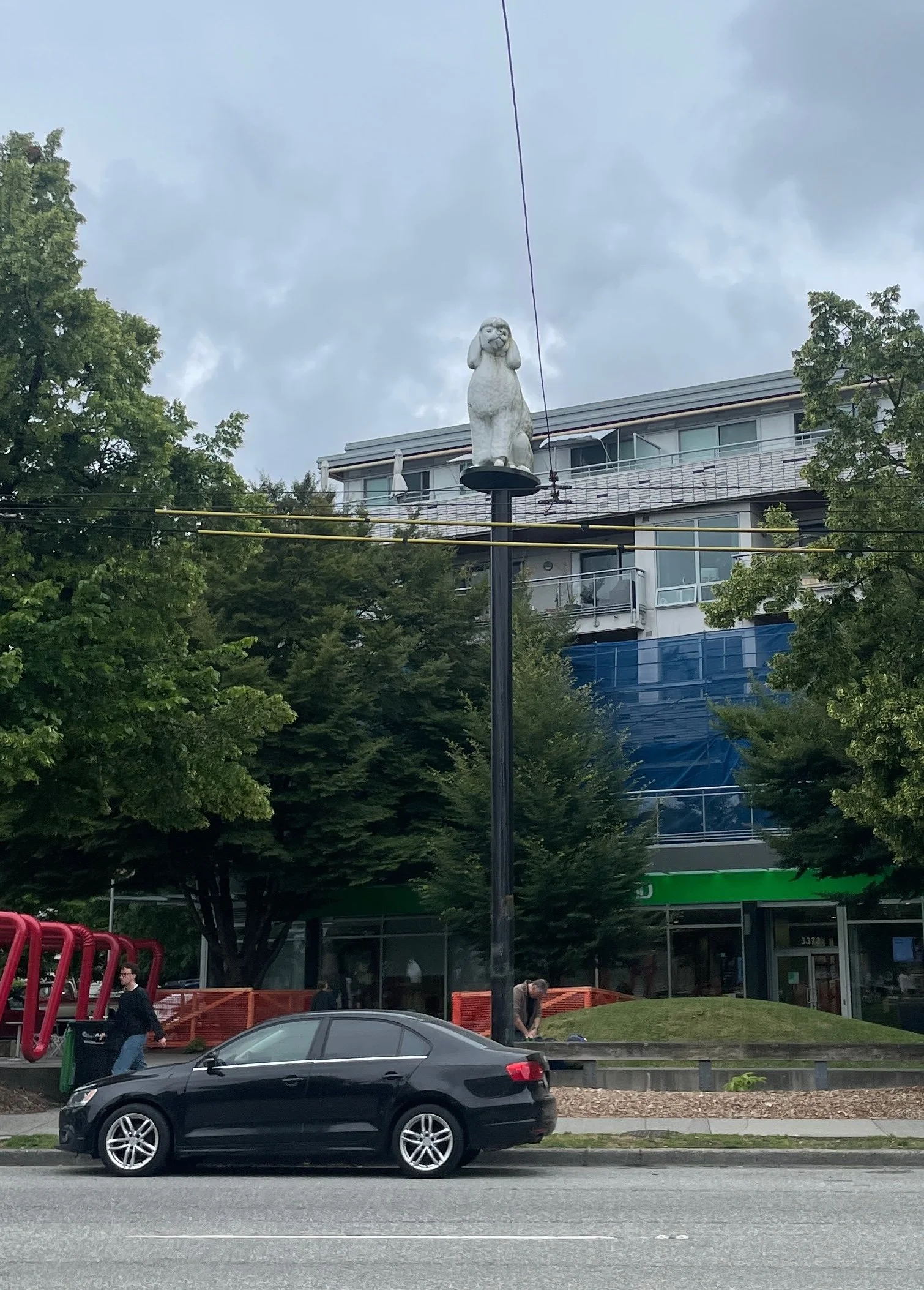
Sun Hop Park’s big white poodle sculpture on a tall pillar. Below is the small grassy nobby hill, in front of the bank.
JUSTIN McELROY: Yes. Which is one of the more particularly mysterious pieces of public art, and public art can be random and fun, and can just be silly with a giant levitating poodle. But when you put it here, it sort of adds to this weird collection of misfit shapes and concepts that doesn't actually come together in any meaningful way. You know, you said this works as a wonderful, sort of like…
HZ: …Novelty.
JUSTIN McELROY: Novelty and sort of like section of a streetscape. And if we were ranking streetscapes, then yes, this, it adds a lot to it. But instead we're ranking parks, and this is the 227th best park in the city out of 243 because there is so little here to offer in the traditional sense of what we want out of a park.
HZ: So the parks that came lower than this were they like this, but they didn't even have the straws.
JUSTIN McELROY: Well, a lot of them are just like empty patches of land where they aren't trying things. This is one of the worst parks in the city where it's clear the city was trying something and spent money and yet it is just not good. And it's a shame because you only have so many chances. To create a new park. You know the old saying, it's like they're not creating any new land. so it takes a lot of work to identify spaces to make it a park to protect it. Here again, it's a place where people are passing through to go to the bank, but are they actually enjoying the space unto itself? No. And that's too bad. I feel sorry for the people that live in this area that were told they were going to get a park, and they thought about all the other ones in the city as a point of reference. And instead, they get a couple of dinky chairs and a weird straw thing that doesn't come together, and this weird nobby hill that you can't actually enjoy for any particular reason.
HZ: Maybe you’re just not a nobby hill kind of enjoyer.
JUSTIN McELROY: I mean, if there were Nobby Hill Enjoyers, we would see them on this hill right now, and yet nowhere to be found by them.
HZ: We've scared them away. They just wanna have some peace. So maybe it would've been better if they hadn't termed this a park?
JUSTIN McELROY: Perhaps, right? Or you could have spent that $500,000 on other parks in the city and pumping those up a little bit more. But to me, this is an example of design by committee, where you hear all of these different ideas that you think are good and try and put them in, but then when you actually take a step back and go, “Well, what about this is appealing for a regular person just to hang out in?” does not meet the mark.
HZ: Alright: so what is a park? Both of us feel, maybe for different reasons, this isn't one: you, because it's failed; me, because they just shouldn't have designated it one in the first place. But what is a park?
JUSTIN McELROY: Yeah. I think ultimately a park is… and it's funny because people sometimes debate: should there be grass, should there be trees? Should there be a playground? Does it need to be a certain size? A park can be anything, that's part of the wonderful flexibility of how we use public spaces. I think, fundamentally, so long as it's a public space that people can hang out in and do a variety of activities, then you got yourself a park.
HZ: Even if those activities aren't hunting? You'll accept?
JUSTIN McELROY: I'll accept, because we're no longer in 17th century Britain. But I traveled the world for the last year before coming back to Vancouver. And you know, every country, every city has different things that they think is an ideal park, and you can see that shape the set-up. But that ability to be different things, I think, is the shining example for what makes them universal.
HZ: Vancouver is a bit imbalanced because it has a lot of little parks and then one massive park at Stanley Park.
JUSTIN McELROY: And Stanley Park is the best park in the city. It might be the best urban park in the world, when you consider just how big it is, the range of things you can do.
HZ: Yeah, they filmed Twilight there.
JUSTIN McELROY: Ha! The amazing views that you have of the mountains and the ocean and the city, that you can jog, that you can bike, that you can walk, that you can see all different sorts of gardens and playgrounds: it's absolutely phenomenal, and an absolute jewel. And it's fun to contrast that with the other 242 that some of them are like Trout Lake, some of them are like this. They can't all be winners, but they're all doing something.
Choklit Park
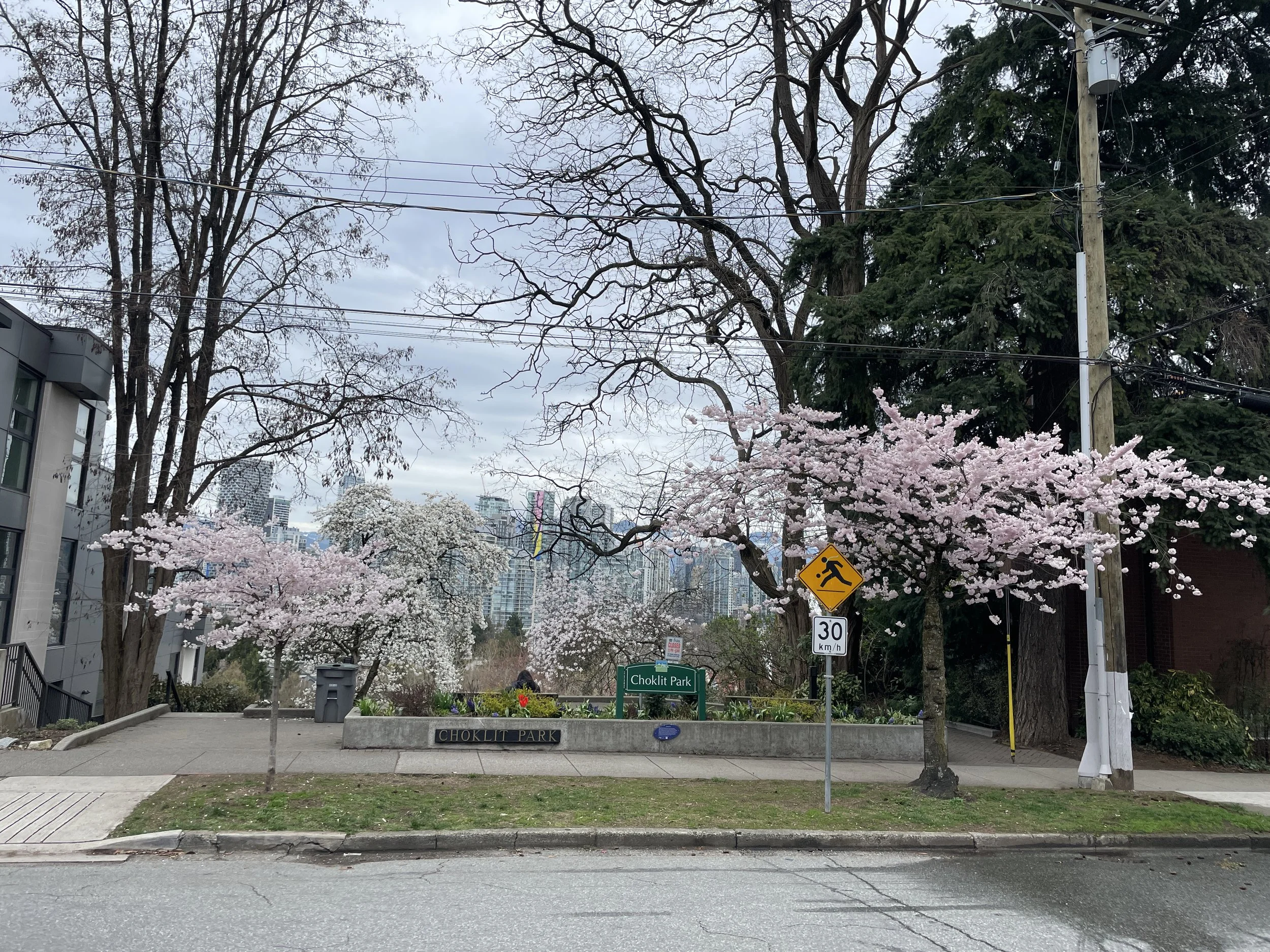
The top end of Choklit Park, with two different signs bearing the park’s name, flanked by trees covered in pink blossom. Behind the trees is a view of the tall silvery buildings of downtown Vancouver.
HZ: One last location change, to another small park, 21 metres wide, the width of the quiet residential street that it plugs, and 35 metres long, half the length of the short side of a city block. This park is built into a steep slope, and from the bottom, you might miss that there's a park at all: it just looks like a flight of stairs going up a chunky concrete wall. But above the forbidding wall, the stairs become a park, winding up between some earthy beds and shrubs to a couple of paved platforms with a bench and a few large handsome trees.
HZ: Now we're in Choklit Park, which also tests my definition of park, because you could just see it as a flight of stairs with a few bushes. Nonetheless, I'm enchanted by it.
JUSTIN McELROY: It is one of the most distinct parks in the city, in the sense of, yeah, there is nowhere else that is essentially a winding staircase down terrace gardens, with a blocked view of downtown by trees.
HZ: Well, in winter the view is great.
JUSTIN McELROY: Yes.
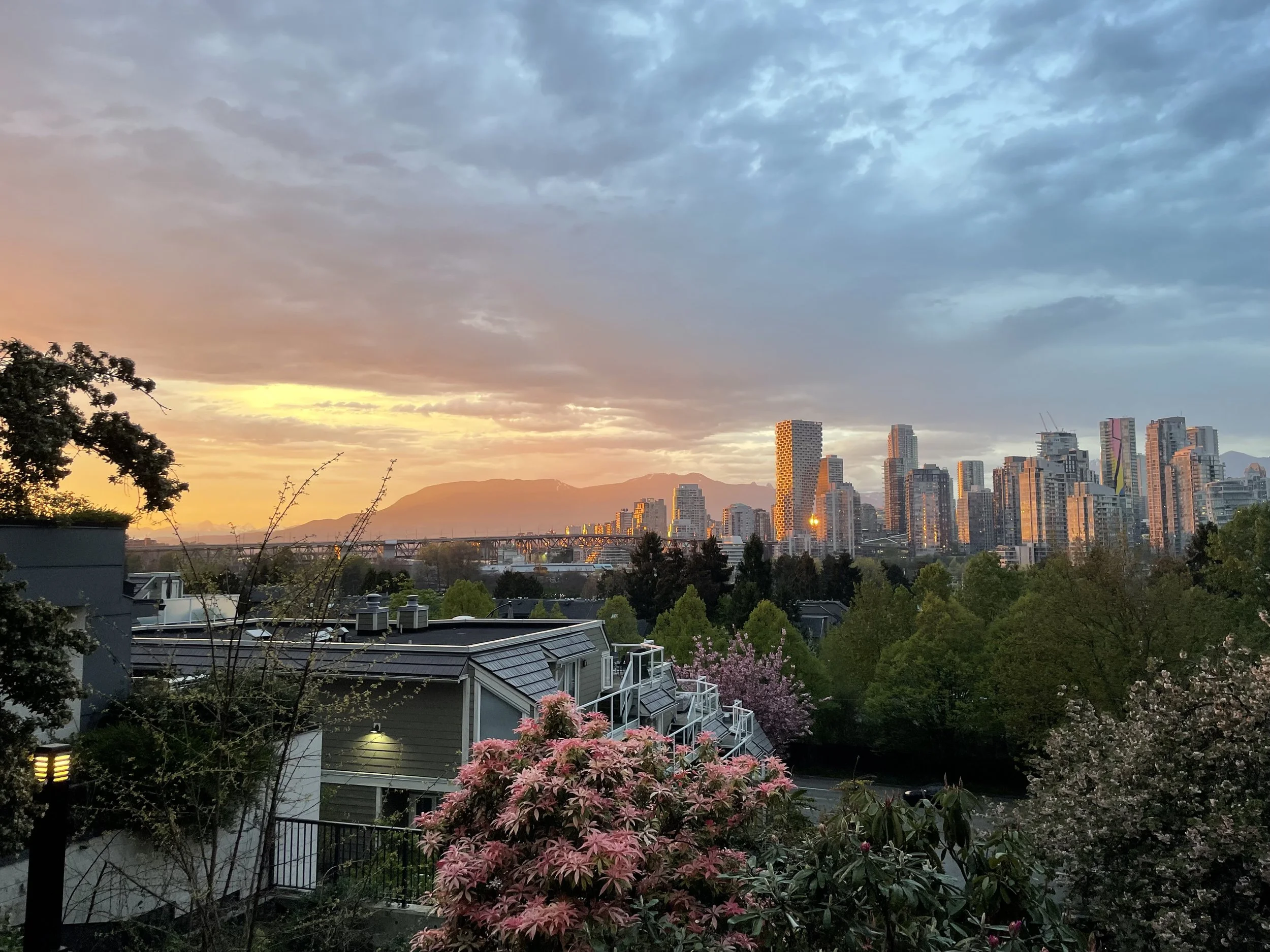
The view from Choklit Park: when the leaves aren’t obstructing the view, you can look across Vancouver to the mountains beyond, and see the buildings of downtown glint in the sunset.
HZ: When the trees have deleafed.
JUSTIN McELROY: Exactly. But it is certainly one of the neatest attempts to make an odd space, something that the public can use, even though I think it's a shell of what it used to be, because there was a playground here originally, that was very log based in the standard of the 1970s, and that got taken away many, many years ago. And so when you look at again: what do you do in this park? Well, there's a young mom and her baby relaxing here with the view, you can do that; but from an activity standpoint, there's nothing to Choklit Park other than, enjoying the blocked view of the trees.
HZ: Yeah, there's not really soft ground to play on. It's a hard surface.
JUSTIN McELROY: It's a hard surface. The most interesting part of the park, to my mind, is the story of how it was created, where there was the land under us used to be one of the sites for Purdy's chocolates. And they had their trucks coming in and out, and they wanted to create a double wide sort of garage to make it easier for them, and the city basically agreed to their request for like changing the parking rules around that to have that wider space. But in exchange, they had to allow a park to happen on top of it. And so that's why this park is this weird terraced staircase, because it's a reflection of what used to operate here and it being essentially on top of all of that. But is it actually good? It's interesting.
HZ: It's far more interesting than if it wasn't termed ‘park’, because it creates a sense of the place where otherwise it might just be purely a staircase, and no one would linger here at all or think it was a thing.
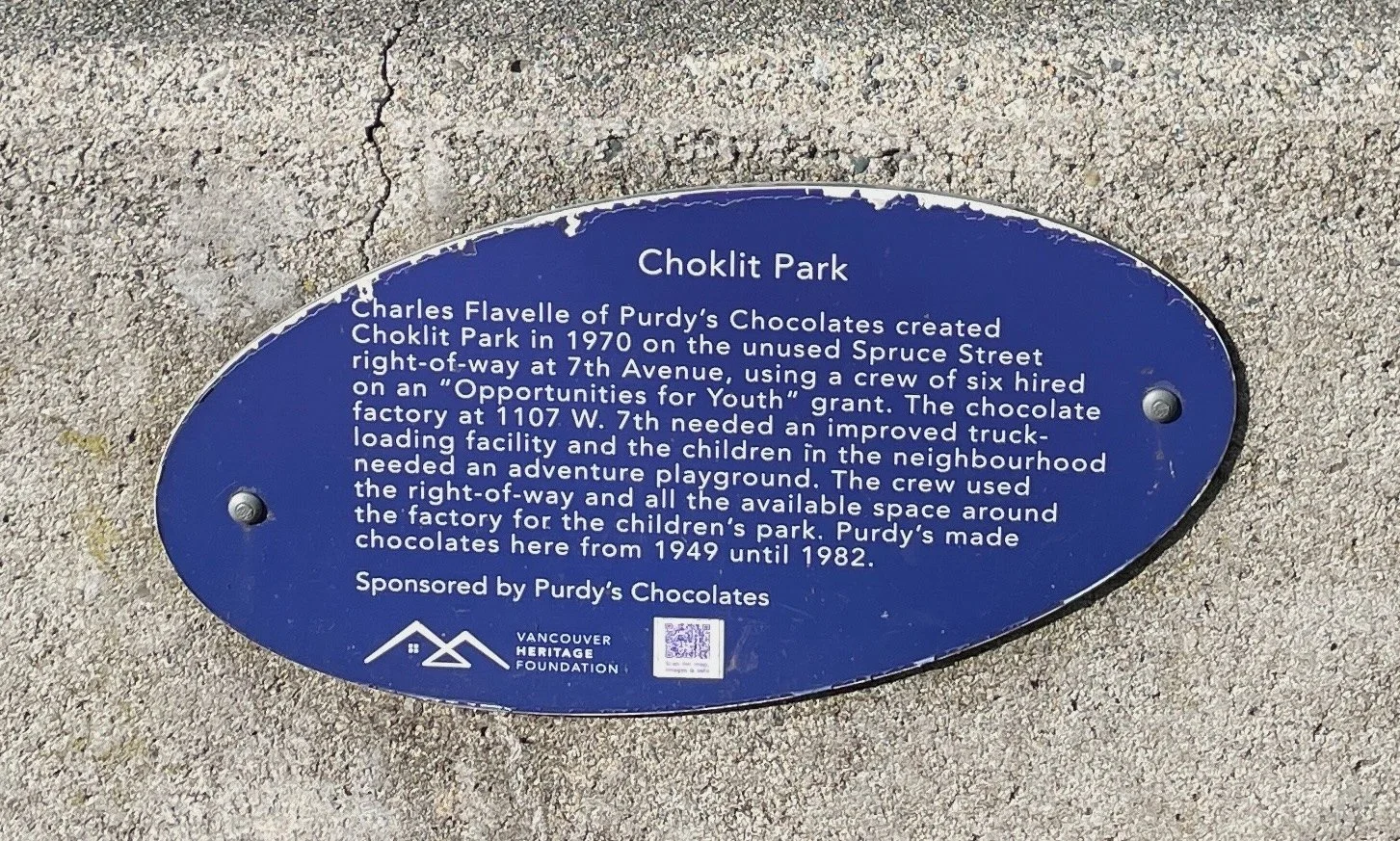
Vancouver Heritage Foundation’s plaque about Choklit Park. It says: “Charles Flavelle of Purdy's Chocolates created Choklit Park in 1970 on the unused Spruce Street right-of-way at 7th Avenue, using a crew of six hired on an ‘Opportunities for Youth’ grant.The chocolate factory at 1107 West 7th needed an improved truck-loading facility and the children in the neighbourhood needed an adventure playground. The crew used the right-of-way and all the available space around the factory for the children's park chocolates here from 1949 until 1982.
Sponsored by Purdy's Chocolates.”
JUSTIN McELROY: Yeah. And also, the name is interesting. We keep saying “chocolate”, but it's spelled C-H-O-K-L-I-T. And the reason for that is because they wanted to have fun with the fact that Purdy's Chocolate is underneath. But the legend is that the owner of the Purdy’s here said, “Spell it like that, because that's how kids would spell it.” Whether that's true or not, I don't know; but it's cute, and it makes it more distinct. And, you know, parks are places of imagination, and it is fun to imagine both what this park once was, and what it could be instead.
HZ: Yeah, and with the name it does encourage one to be playful. And if this was named something like Bob...
JUSTIN McELROY: …Hendry.
HZ: Yeah, Bob Hendry Park, then I don't think we'd be here.
JUSTIN McELROY: It would lose a little bit of its charm, right? Yeah.
HZ: Justin McElroy is Municipal Affairs Reporter for CBC Vancouver, and recently returned from visiting 52 countries in 52 weeks, which you can read all about at his Substack. He is also a ranker of things - ice creams, doughnuts, breweries, Canadian Heritage Minutes, roadside attractions, and of course Vancouver’s parks: check out his rankings at VancouverParkGuide.ca.
What’s your favourite or most confusing park? I was spoiled by living for more than a decade next to one of London’s most excellent parks, Crystal Palace Park, which not only has a glamorous-sounding name, contains such excitements as Victorian dinosaur statues, London’s largest maze, a tiny farm, three lakes, a concert stage, six sphinxes, some headless statues, beach volleyball courts - Justin would have loved it, even though there’s no longer an artificial ski slope there. Anyway, tell me your thoughts about what makes a park or what’s a great park name: find @allusionistshow on Instagram, Facebook, BlueSky and YouTube.
Your randomly selected word from the dictionary today is…
fipple, noun: the mouthpiece of a recorder or similar wind instrument which is blown endwise, in which a thin channel cut through a block directs a stream of air against a sharp edge.
Try using ‘fipple’ in an email today.
This episode was produced by me, Helen Zaltzman, with transport and music provided by the singer and composer Martin Austwick of palebirdmusic.com. Thanks also to Mars Zaltzman and Andrea Warner.
on the unceded ancestral and traditional territory of the xʷməθkʷəy̓əm (Musqueam), Sḵwx̱wú7mesh (Squamish), and səlilwətaɬ (Tsleil-Waututh) Nations.
In local language news, Vancouver at long last has renamed Trutch Street, the eponymous Joseph Trutch was an English man who held power in British Columbia in the 1860s-1890, including as the province’s first lieutenant governor. His policies were very destructive to Indigenous people, decimating the areas of their lands, and still have significant impacts today. In 2021 the city agreed to rename the street - like I said, eponyms should have a statute of limitations, it would probably save admin in the long run - and in June 2025, new signs went up. The street is now called šxʷməθkʷəy̓əmasəm, in translation Musqueamview Street. The situation continues to be complicated, and we’ll hopefully hear people talk about why in a later episode of the show.
Our ad partner is Multitude. To sponsor this show, get in touch with them at multitude.productions/ads.
And you can hear or read every episode, get more information about the topics and guests and pictures of the parks we visited, and see the full dictionary entries for the randomly selected words, and keep track of the events that are coming up, like the meetup, the Double Dicks watchalong, live shows and such; all the show’s forever home theallusionist.org.
