• Episodes
  • Listen
  • Transcripts
  • Tranquillusionist
  • Events
  • Lexicon
  • Donate
  • Contact
  • Merch
Menu

The Allusionist

Street Address
City, State, Zip
Phone Number
A PODCAST ABOUT LANGUAGE
BY HELEN ZALTZMAN

Your Custom Text Here

The Allusionist

  • Episodes
  • Listen
  • Transcripts
  • Tranquillusionist
  • Events
  • Lexicon
  • Donate
  • Contact
  • Merch

Allusionist 203. Flyting

November 9, 2024 The Allusionist

MP3 • APPLE PODCASTS • RSS • TRANSCRIPT

In 15th and 16th century Scotland, in the highest courts of the land, you'd find esteemed poets hurling insults at each other. This was flyting, a sort of medieval equivalent of battle rap, and it was so popular at the time that the King himself wrote instructions for how to do it well.

Writer and Scots language campaigner Ishbel McFarlane and historical linguist Joanna Kopaczyk explain the art of flyting, where an insult becomes slander, what's going on within the speech act of performative diss-trading, and what the legal consequences could be of being accused of witchcraft.

Content note: this episode contains brief references to historical capital and corporal punishments, and discussion of insults and slurs; there is also a derogatory term for sex workers, and category A and B swears.

Hey, I’m doing a special live show in Vancouver BC on 12 January 2025, for the Allusionist’s 10th birthday!
Get your tickets from the Rio Cinema.

EXTRA MATERIALS:

  • Otherlusionists: listen to Ishbel talking about Scots language in Oot In The Open; hear more about speech acts in Sorry, which is about apologies; swear along with the Swearalong Quiz; and I’ll always take the opportunity to recommend the gentle Scots mystery of the name Fiona, parts 1 and 2.

  • ‘Flyting’ in the Dictionaries of the Scots Language, with usage examples over time.

  • Read the famous flytings of William Dunbar and Walter Kennedy - and here’s what the first print version looked like.

  • For many centuries before the time period we’re talking about this episode, flyting was A Thing in many cultures. A variant was the Old English bēot, although it sounds less funny and more arrogant.

  • Joanna was in the BBC documentary Scotland: Contains Strong Language, showing the first printed instance of the word ‘fuck’.

  • A bill is in process with the Scottish parliament to obtain official language status for Scots and Gaelic in Scotland.

  • “Owls aren’t doing calculus. Their immense eyes can see their prey by the light of one candle. Their enormous mouths can swallow a rat whole. Put the eyes, ears and mouth together and that leaves very little room in an owl’s skull for a brain. Approximately 1/3 or less of the skull’s volume is dedicated to owl brain.”

  • Sorry, I was wrong - Tim Clare’s book is called The Game Changers: How Playing Games Changed the World and Can Change You Too! Gah, this is what happens when I work silly hours!

To help fund this independent podcast, take yourself to theallusionist.org/donate and become a member of the Allusioverse. You get regular livestreams with me and my collection of reference books, inside scoops into the making of this show, and watchalong parties - we're enjoying Merchant Ivory films, the current seasons of Great British Bake Off and the Canadian version, and Taskmaster featuring my brother Andy. Coming up, we've got Pride & Prejudice, and Carol! And best of all, you get to bask in the company of your fellow Allusionauts in our delightful Discord community. 

YOUR RANDOMLY SELECTED WORD FROM THE DICTIONARY:
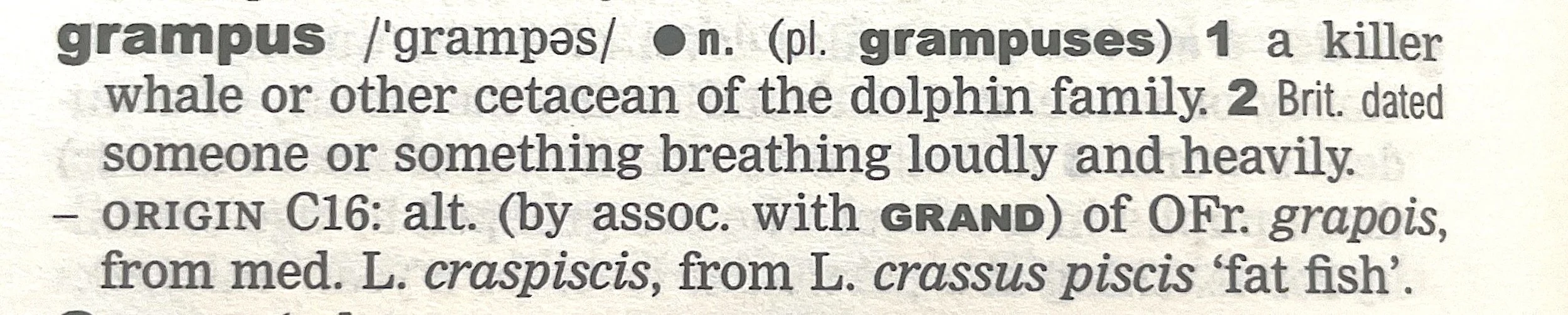
grampus
, noun (pl. grampuses):
1. a killer whale or other cetacean of the dolphin family.
2. British, dated: someone or something breathing loudly and heavily.
Origin 16th century: alteration (by assoc. with ‘grand’) of Old French grapois,
from medieval Latin. craspiscis,
from Latin crassus piscis 'fat fish'.
CREDITS:

  • Ishbel McFarlane is a writer, performer and campaigner for the Scots language. Find out more about her work at ishbelmcfarlane.wordpress.com, and listen to her podcast series Edwin Morgan’s Second Life, about the poet Edwin Morgan.

  • Joanna Kopaczyk is a historical linguist, and Professor of Scots and English Philology at the University of Glasgow. She is involved in the Future of Scots, a collaborative project working on community-driven policy for the language,

  • This episode was produced by me, Helen Zaltzman, on the unceded ancestral and traditional territory of the xʷməθkʷəy̓əm (Musqueam), Sḵwx̱wú7mesh (Squamish), and səlilwətaɬ (Tsleil-Waututh) Nations.

  • The original Allusionist music is by Martin Austwick. Download his songs at palebirdmusic.com and listen to his podcasts Song By Song and Neutrino Watch.

  • Find the Allusionist at youtube.com/allusionistshow, instagram.com/allusionistshow,  facebook.com/allusionistshow, @allusionistshow.bsky.social… Essentially: if I’m there, I’m there as @allusionistshow. 

Back in two weeks with a new episode - HZ.

Our ad partner is Multitude. If you want me to talk compellingly about your product, sponsor an episode: contact Multitude at multitude.productions/ads.

In episodes Tags society, culture, words, language, arts, history, Ishbel McFarlane, Joanna Kopaczyk, Scots, Scotland, Scottish, flyting, fleetan, poets, poetry, medieval, court, royal, monarchs, kings, James IV, James VI, writers, entertainment, combat, performance, insults, slurs, swears, obscenity, comedy, literature, printing press, legal, law, witches, witchcraft, trials, lawsuits, roast, vulgarity, abuse, scat, makars, historical pragmatics, rhyme, alliteration, taboos, offensive, offence, owls, contests, competitions, politeness, impoliteness, profanity, speech acts, communication, rude, slander, music hall, Virgil, Aeneid, grampus, shit, shite, fuck
← Allusionist 204. Lexicat, part 1Allusionist 202: Singlish Singlish →
Allusionist Patreon
Featured
Tranquillusionist: cheesy cheesybobs

This is the Tranquillusionist, in which I, Helen Zaltzman, say a series of words to relax your mind, replace a hectic interior monologue, maybe lull you to sleep, hopefully quell the mental uproar just for a little while.

Today: nicknames for woodlice AKA rolypoly bugs AKA slaters AKA all these other things; and a list of cheeses from Great Britain and Ireland.

Read more →
78AF926C-7878-4567-A87F-13CFF415B647_1_105_c.jpeg
sorry lads, we're getting bad ads

TL;DR version:

  • For the show's financial survival (hopefully), over the next few weeks I'm having to switch on programmatic advertisements. This means, for the first time in the show's nearly 12-year existence, you may be subjected to ads that are not voiced, scripted and individually approved by me.

  • If you would prefer to listen to the show without ads in it, patreonise the show at the Gravy, Wedge or Check tiers, which include the perk of an ad-free RSS feed.

Click through to read the rest of the post about why I’m doing this thing I don’t want to do.

Read more →
Allusionist 231. Lingthusionist

“Linguistics and language is such a good mechanism for being curious,” says Lauren Gawne, linguistics prof, author of the book Gesture, and cohost of the podcast Lingthusiasm. I'm in vacation mode (although not on actual vacation alas), so today's episode is a fun chat with our nice pal about making language podcasts, the firey digestive punishments for linguistics researchers, working in reality television, and cute tame nouns versus scary intimidating verbs.

Read more →
Allusionist 230. Draculae part 4: Transformation

Throughout the Draculae miniseries, about the Swedish and Icelandic translations of Dracula that played fast and loose with the original text, I've been wondering a couple of questions: why are cover versions of songs and remakes of films so normal and acceptable, whereas cover versions in book form cause such a stir? And do these Scandinavian Draculae count as fan fiction? And if not, why not? Fansplaining.com's Elizabeth Minkel explains what fan fiction can mean.

Read more →
Allusionist 229. Draculae part 3: Hunting Down the Count

Many mysteries accompany the revelations that Powers of Darkness, the Icelandic and Swedish versions of Dracula, are not direct translations of Bram Stoker's original, but stories that significantly differ in character names, plot and runtime. Like: did Bram Stoker write it himself, to publish some raunchy content that British censors would forbid? Was Powers of Darkness based on his early drafts? And did he really not copyright Dracula in the USA was that a deliberate ruse? Welllll... brace yourself for ole thrill-destroyer Zaltzman to pop your balloons of excitement.

Read more →
queer playlist
Read more →
Allusionist 228. Draculae part 2: Surprises in the Vaults

Happy World Dracula Day to all who celebrate!

This is the second episode of the Draculae miniseries, about a literary mystery which came to me via a meme: “Someone translated Dracula into Icelandic, and it took over 100 years for anyone to point out he just made a fanfic rewrite of what he wanted the story to be.”

In Draculae part 2, Ásgeir Jónsson explains how he got that Icelandic adaptation of Dracula back into print, to little fanfare - but then Dutch scholar Hans Corneel de Roos set about making an English translation. Following that: like me, Will Trimble also got meme-struck, and that propelled him to get a translation of the Swedish version that begat the Icelandic one.

Before listening to this, check out the first episode of the Draculae miniseries explaining the three versions of Dracula: Dracula published by Bram Stoker in 1897; the Icelandic version Makt Myrkranna by newspaper editor Valdimar Ásmundsson, serialised in his newspaper Fyallkonan in 1900-1901; and the Swedish version Mörkrets makter by an author known only as A—e, and serialised in a couple of Swedish newspapers 1899-1900.

Read more →
Allusionist 227. Draculae part 1: Enter the Castle

A literary mystery came to me via a meme.

Read more →
Allusionist 226. Suburbia

"The word ‘suburbia’ sort of evokes a very fixed idea of a place that is identikit, that all suburbs are the same, that within the suburb everything is the same, that all people are the same, all experiences are the same," says social historian and author John Grindrod. "I think it has this kind of flattening-out facility, that word, that isn't true."

Read more →
Allusionist 225. Hues

You know what's an absolutely pesky kind of word to define in a dictionary? Colour names. A passel of lexicographers spent years - decades, even - trying different ways to describe colours in words for Webster's Third International Dictionary. It was such a huge, complicated effort that it took twelve years for former Merriam-Webster lexicographer Kory Stamper to write a book about it.

Read more →
Allusionist 224. Cosmic Hairball

Pack your oxygen tank, we're going up to space. There’s a lot of etymology up there.

Read more →
Allusionist 223. Bonus 2025
Read more →
Allusionist 222. A Christmas Carol

Today, we read the novelisation of The Muppet Christmas Carol, also known as the 1843 festive lit hit A Christmas Carol by Charles Dickens.

Read more →
Allusionist 221. Scribe

"I have never felt so naked. That's how exposed I felt at the idea that my handwriting was going to be seen by the world," says Tim Brookes, founder of the Endangered Alphabets Project and author of the new book about handwriting By Hand: Can the Art of Writing Be Saved? Writing the book (yes, by hand!) celebrates the act of handwriting, even overcoming the shame arising from his own.

Read more →
Allusionist 220. Disobedience

“The more we look into social structures, the more many of us realize we don't fit into them," says So Mayer, author of the new book Bad Language, "So each phrase or set of vocabulary is another piece of that dismantlement.” We discuss finding vocabulary for oneself, coming out as a speech act, growing up under Section 28, busting through oppression and shame, and joyous listening.

Read more →
Creative Commons Licence
The Allusionist by Helen Zaltzman is licensed under a Creative Commons Attribution-NonCommercial-NoDerivatives 4.0 International License.