• Episodes
  • Listen
  • Transcripts
  • Tranquillusionist
  • Events
  • Lexicon
  • Donate
  • Contact
  • Merch
Menu

The Allusionist

Street Address
City, State, Zip
Phone Number
A PODCAST ABOUT LANGUAGE
BY HELEN ZALTZMAN

Your Custom Text Here

The Allusionist

  • Episodes
  • Listen
  • Transcripts
  • Tranquillusionist
  • Events
  • Lexicon
  • Donate
  • Contact
  • Merch

Allusionist 220. Disobedience

November 9, 2025 The Allusionist
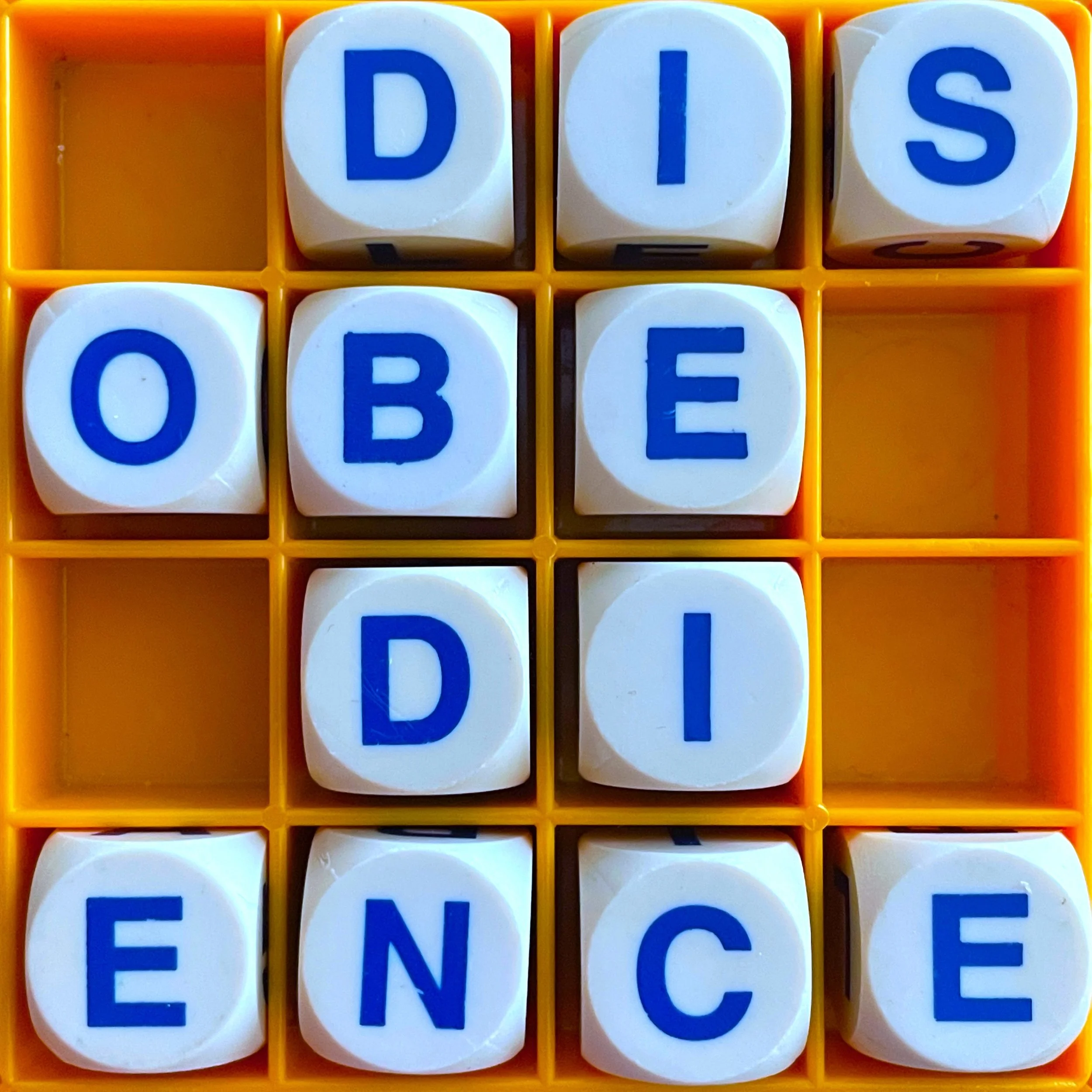
a Boggle grid spelling out the word disobedience

MP3 • APPLE PODCASTS • RSS • GOOGLE • POCKETCASTS • TRANSCRIPT

“The more we look into social structures, the more many of us realize we don't fit into them," says So Mayer, author of the new book Bad Language. "So each phrase or set of vocabulary is another piece of that dismantlement.” We discuss finding vocabulary for oneself, coming out as a speech act, growing up under Section 28, busting through oppression and shame, and joyous listening.

Content note: in the episode we refer to sexual abuse or crimes against consent, and to suicide, but we do not go into any detail about these things, or describe any experiences. Also there are some category A and B swears.

EXTRA MATERIALS:

  • Miranda Fricker who coined ‘testimonial injustice’ and ‘hermaneutical injustice’ as types of epistemic injustice has several publications on the topic.

  • “Gay men spoke of “coming out” into gay society — borrowing the term from debutante society, where elite young women came out into high society. A 1931 news article in the Baltimore Afro-American referred to ‘the coming out of new debutantes into homosexual society.’ It was titled ‘1931 Debutantes Bow at Local ‘Pansy’ Ball.’ The 1930s, 40s and 50s witnessed a growing backlash against this visible gay world. In response, gay life became more secretive.”

  • Alumsionist Paul Baker has written a book Outrageous! The Story of Section 28 and Britain’s Battle for LGBT Education, a personal history of the anti-gay law that was in place throughout nearly my entire time in formal education.

  • “Years later, Baroness Knight sought to explain her involvement in the implementation of the hated legislation… in 2018, she told BBC’s Newsnight: “The intention was the wellbeing of children. And if I got that wrong, well, I’m sorry… and nobody told me at that time.” That seems unlikely. Indeed, even a cursory inspection of Hansard (the official report of parliamentary debates) suggests that there were MPs at the time who were vehemently opposed to the legislation. For example, Labour’s Tony Benn, argued: “If the sense of the word ‘promote’ can be read across from ‘describe’, every murder play promotes murder.””

  • Today I happened to be reading an interview with author Olivia Laing (who used to be my editor many many years ago when both our careers were very different!) and they said this which resounded with the episode I was finishing:

    “I grew up in a gay family. My mum was gay in the 1980s in the U.K., which was a time of intense state-sponsored homophobia. There was a law called Section 28, which meant that schools and local councils couldn’t teach about the so-called “pretended-family relationship” of homosexuality. It was really about the gay family almost above all else.

    So to live in a gay family, in those times where you are actually explicitly outlawed, and to grow up inside that kind of closet, and then to come into teenage years during the AIDS crisis, and to experience that level of hatred is to give you a really strong insight into how some types of bodies—how some types of people—are treated compared to others, and to have a deep, intrinsic skepticism about the state’s capacity to put people into categories and to treat people in some of those categories in absolute different ways to others; to make people feel that these divisions are natural and that the people who are the natural category that’s applauded, that’s desired, don’t even see until they find themselves crossing over those lines.”

  • Mae Martin on shame: “I think guilt can be helpful. If you do something bad, guilt and empathy can motivate you to change. But I don’t think shame motivates you to change. I think it motivates you to self-destruct, so I think we’ve got to get rid of it.”

  • Non-aligned countries.

  • Otherlusionists relevant to this one: reclaiming the cunt word; erasure of queer identities is mentioned in the episodes about bisexuality and being aromantic/asexual; and we very recently talked about book bans.

Arnie Niekamp of Hello from the Magic Tavern has a new podcast out called No Skip Christmas; it’s all about Christmas music, and I got to be a guest on it to talk about one of my favourite topics, the difference between the UK and US festive pop canon. Listen here or in the usual podplaces.

Support the show at theallusionist.org/donate and as well as keeping this independent podcast going, you also get behind-the-scenes info about every episode; livestreams with me reading from my ever-growing collection of dictionaries; and the charming and nurturing Allusioverse Discord community, where among daily sharing of thoughts and amusements, we're watching The Princess Bride, the current season of The Great Canadian Baking Show, and the new yarncraft competition Game of Wool.

If you sign up for free, you don’t get those things but you do get the occasional mail with Zaltznews.

YOUR RANDOMLY SELECTED WORD FROM THE DICTIONARY:
leman, noun (plural lemans) archaic: a lover or sweetheart.
Origin Middle English leofman, from lēof (see lief) + man.

dictionary entry for the word 'leman'

CREDITS:

  • So Mayer is a writer, organiser, publisher, and bookseller at the independent bookshop Burley Fisher Books in Haggerston in London. Find their work at somayer.net. Their latest book Bad Language is out 13 November 2025 from Peninsula Books, and they co-edited another new book: The Word for World: The Maps of Ursula K Le Guin, there’s also a free exhibition to go with that book at the Architectural Association in London, until 6 December 2025.

  • This episode was produced by me, Helen Zaltzman, on the unceded ancestral and traditional territory of the xʷməθkʷəy̓əm (Musqueam), Sḵwx̱wú7mesh (Squamish), and səlilwətaɬ (Tsleil-Waututh) Nations.

  • Music and editorial assistance was provided by Martin Austwick. Download his songs at palebirdmusic.com and listen to his podcasts Song By Song and Neutrino Watch.

  • Find the Allusionist at youtube.com/allusionistshow, instagram.com/allusionistshow, facebook.com/allusionistshow, @allusionistshow.bsky.social… If I’m there, I’m there as @allusionistshow. 

Back in two weeks with a new episode - HZ.

Our ad partner is Multitude. If you want me to talk compellingly about your product, sponsor an episode: contact Multitude at multitude.productions/ads. This episode is sponsored by:

• Squarespace, your one-stop shop for building and running your online forever home. Go to squarespace.com/allusionist for a free trial, and get 10 percent off your first purchase of a website or domain with the code allusionist.
• Home Chef, meal kits that fit your needs. For a limited time, Home Chef is offering Allusionist listeners fifty per cent off and free shipping on your first box, plus free dessert for life, at HomeChef.com/allusionist.
• Rosetta Stone, immersive and effective language learning. Allusionist listeners get 50% off unlimited access to all 25 language courses, for life: go to RosettaStone.com/allusionist.
• Uncommon Goods, which sells thousands of one-of-a-kind gifts. To get 15% off your next purchase, go to UncommonGoods.com/allusionist.

In episodes Tags lexicon, society, culture, words, language, books, So Mayer, libraries, librarians, library, teachers, gender, QUILTBAG, LGBTQIA++, quilting, knitting, punk, disobedience, consent, queer, non-binary, speech acts, bad language, power, coming out, debutantes, oppression, control, dictionaries, cunt, assimilation, non-aligned, erasure, witchcraft, epistemic injustice, listening, hearing, homophobia, transphobia, crimes against consent, abuse, feminism, philosophy, compliance, Adrianne Rich, Melanie Kaye/Kantrowitz, Irena Klepfisz, shame, singing, magic, hermeneutical injustice, leman, testimonial injustice, vulnerable
← Allusionist 221. ScribeAllusionist 219. Making Trouble →
Allusionist Patreon
Featured
Allusionist 231. Lingthusionist

“Linguistics and language is such a good mechanism for being curious,” says Lauren Gawne, linguistics prof, author of the book Gesture, and cohost of the podcast Lingthusiasm. I'm in vacation mode (although not on actual vacation alas), so today's episode is a fun chat with our nice pal about making language podcasts, the firey digestive punishments for linguistics researchers, working in reality television, and cute tame nouns versus scary intimidating verbs.

Read more →
Allusionist 230. Draculae part 4: Transformation

Throughout the Draculae miniseries, about the Swedish and Icelandic translations of Dracula that played fast and loose with the original text, I've been wondering a couple of questions: why are cover versions of songs and remakes of films so normal and acceptable, whereas cover versions in book form cause such a stir? And do these Scandinavian Draculae count as fan fiction? And if not, why not? Fansplaining.com's Elizabeth Minkel explains what fan fiction can mean.

Read more →
Allusionist 229. Draculae part 3: Hunting Down the Count

Many mysteries accompany the revelations that Powers of Darkness, the Icelandic and Swedish versions of Dracula, are not direct translations of Bram Stoker's original, but stories that significantly differ in character names, plot and runtime. Like: did Bram Stoker write it himself, to publish some raunchy content that British censors would forbid? Was Powers of Darkness based on his early drafts? And did he really not copyright Dracula in the USA was that a deliberate ruse? Welllll... brace yourself for ole thrill-destroyer Zaltzman to pop your balloons of excitement.

Read more →
queer playlist
Read more →
Allusionist 228. Draculae part 2: Surprises in the Vaults

Happy World Dracula Day to all who celebrate!

This is the second episode of the Draculae miniseries, about a literary mystery which came to me via a meme: “Someone translated Dracula into Icelandic, and it took over 100 years for anyone to point out he just made a fanfic rewrite of what he wanted the story to be.”

In Draculae part 2, Ásgeir Jónsson explains how he got that Icelandic adaptation of Dracula back into print, to little fanfare - but then Dutch scholar Hans Corneel de Roos set about making an English translation. Following that: like me, Will Trimble also got meme-struck, and that propelled him to get a translation of the Swedish version that begat the Icelandic one.

Before listening to this, check out the first episode of the Draculae miniseries explaining the three versions of Dracula: Dracula published by Bram Stoker in 1897; the Icelandic version Makt Myrkranna by newspaper editor Valdimar Ásmundsson, serialised in his newspaper Fyallkonan in 1900-1901; and the Swedish version Mörkrets makter by an author known only as A—e, and serialised in a couple of Swedish newspapers 1899-1900.

Read more →
Allusionist 227. Draculae part 1: Enter the Castle

A literary mystery came to me via a meme.

Read more →
Allusionist 226. Suburbia

"The word ‘suburbia’ sort of evokes a very fixed idea of a place that is identikit, that all suburbs are the same, that within the suburb everything is the same, that all people are the same, all experiences are the same," says social historian and author John Grindrod. "I think it has this kind of flattening-out facility, that word, that isn't true."

Read more →
Allusionist 225. Hues

You know what's an absolutely pesky kind of word to define in a dictionary? Colour names. A passel of lexicographers spent years - decades, even - trying different ways to describe colours in words for Webster's Third International Dictionary. It was such a huge, complicated effort that it took twelve years for former Merriam-Webster lexicographer Kory Stamper to write a book about it.

Read more →
Allusionist 224. Cosmic Hairball

Pack your oxygen tank, we're going up to space. There’s a lot of etymology up there.

Read more →
Allusionist 223. Bonus 2025
Read more →
Allusionist 222. A Christmas Carol

Today, we read the novelisation of The Muppet Christmas Carol, also known as the 1843 festive lit hit A Christmas Carol by Charles Dickens.

Read more →
Allusionist 221. Scribe

"I have never felt so naked. That's how exposed I felt at the idea that my handwriting was going to be seen by the world," says Tim Brookes, founder of the Endangered Alphabets Project and author of the new book about handwriting By Hand: Can the Art of Writing Be Saved? Writing the book (yes, by hand!) celebrates the act of handwriting, even overcoming the shame arising from his own.

Read more →
Allusionist 220. Disobedience

“The more we look into social structures, the more many of us realize we don't fit into them," says So Mayer, author of the new book Bad Language, "So each phrase or set of vocabulary is another piece of that dismantlement.” We discuss finding vocabulary for oneself, coming out as a speech act, growing up under Section 28, busting through oppression and shame, and joyous listening.

Read more →
Allusionist 219. Making Trouble

A change of scene for one episode: recently the brilliant poet and performer Molly Naylor interviewed me for her podcast Making Trouble, about creativity, and she kindly let me run a version of that episode here for you. We're talking about ideas, but also long-term creative careers, mortality, podcasting, external validation, and Molly offers some great prompts for either sparking ideas or making a dinner conversation a bit more lively.

Read more →
Allusionist 218. Banned Books

It's Banned Books Week. Honorary youth chair Iris Mogul and Sam Helmick, president of the American Library Association, talk about what it is, why it matters so much, and how you can get involved.

Read more →
Creative Commons Licence
The Allusionist by Helen Zaltzman is licensed under a Creative Commons Attribution-NonCommercial-NoDerivatives 4.0 International License.